
Why Hospital Operational Challenges Stem from the Same Issue
Key Takeaways
- Hospitals lose millions to seemingly unrelated problems, from missing equipment to delayed discharges. The root cause is a lack of real-time visibility, forcing teams to decide based on incomplete information.
- Small gaps compound into lost capacity and cost. 22% of US inpatient days are not clinically necessary, and nurses spend up to 36 minutes per shift looking for equipment.
- Fixing the root cause beats optimizing problems in isolation. A unified, real-time view of patients, staff, assets, and environments lets leaders catch problems early and prevent hidden costs from compounding.
Most hospitals are well-run organizations staffed by capable, committed people. Yet many still lose millions of dollars each year to problems that, at first glance, seem unrelated: a missing IV pump, a staff safety incident, a delayed discharge, a spoiled vaccine, or the hours clinicians spend on tasks that have nothing to do with patient care.
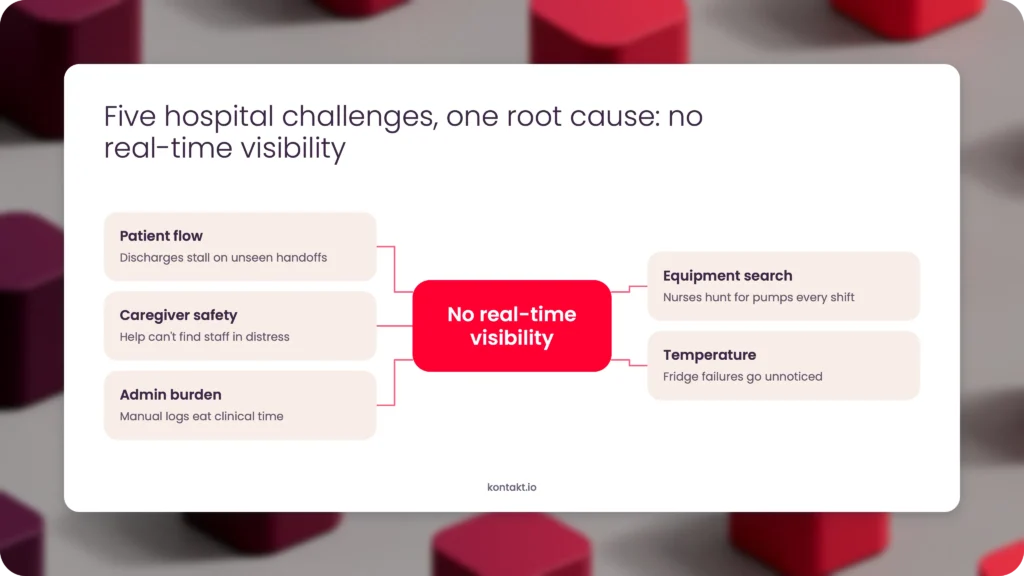
These are not isolated failures. They are symptoms of a single, structural problem: hospitals lack real-time visibility into what is happening across their own operations. Without it, teams make decisions from incomplete information, problems surface too late to prevent, and the organization absorbs costs that never appear on a single line in the budget.
The five challenges below illustrate how this plays out in practice.
Patient Flow
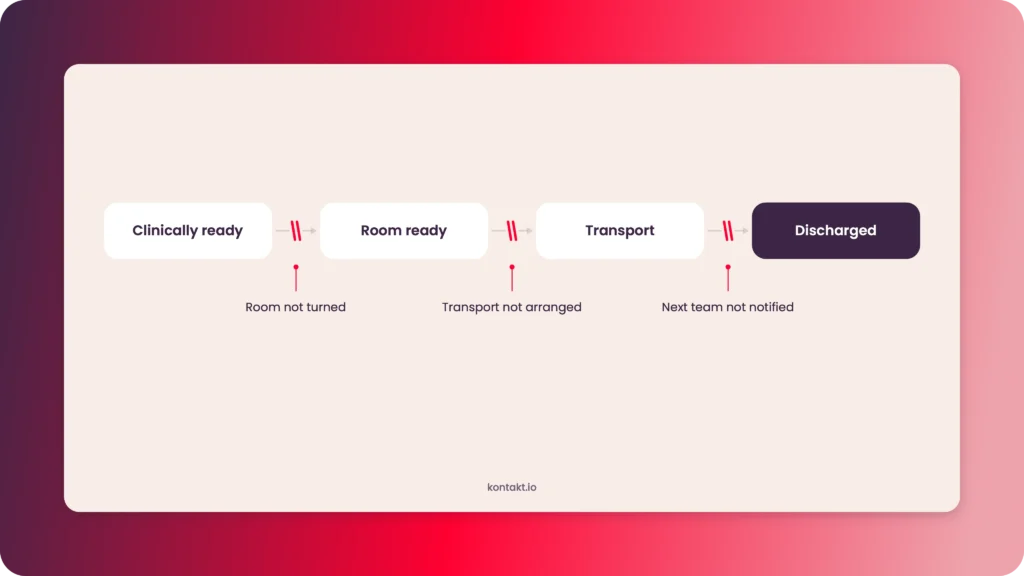
When a patient is clinically ready for discharge but the room has not been turned, transport has not been arranged, or the next team has not been notified, no single delay seems catastrophic. Compounded across hundreds of patients and dozens of units, however, these gaps erode real capacity.
Research has found that 22 percent of U.S. inpatient hospital days are not clinically necessary. For a 200-bed hospital, closing that gap represents both recoverable cost and additional revenue. The barrier is the difficulty of coordinating many small actions across teams that each have partial, delayed views; this results in inefficient patient flows with hundreds of unseen bottlenecks.
Equipment Loss and Search Time
Nurses and other staff routinely spend up to 36 minutes per shift searching for equipment, and studies estimate that equipment searches account for 26.2 percent of all operational failures. Between 10 and 20 percent of a hospital’s mobile assets are lost or stolen over their usable lifetimes, at a replacement cost of roughly $3,000 per item.
The typical institutional response is to purchase or rent more, which converts an operational shortcoming into a capital expense. Even hospitals with real-time location systems often stop at knowing where an asset is, which does not ensure that it is clean, staged, and available where demand requires it.
The issue goes beyond simply finding equipment; instead, it’s about whether organizations can reliably match supply to need without constant manual effort.
Caregiver Safety
The American Nurses Association reports that 81.6% of nurses have experienced workplace violence. Beyond the immediate human cost, this has direct operational consequences: lower retention, higher absenteeism, and reduced willingness to work in high-risk settings. Staffing instability, in turn, affects care delivery in ways that are difficult to quantify but impossible to ignore.
Staff safety technology matters not only because it improves incident response, but because it reduces uncertainty when seconds determine outcomes. A system that can locate a staff member in distress and route help precisely and immediately will protect caregivers and provide peace of mind, enabling them to work more efficiently.
Temperature Monitoring
Temperature monitoring may appear narrower than the other challenges here, but it reflects the same underlying gap between visibility and real-time data. When refrigerators fail or their doors are left open, vaccines can be compromised long before anyone notices, particularly where monitoring is periodic rather than continuous.
One study estimates that worldwide, up to 35% of vaccines were exposed to extreme temperatures, running the risk of wasted doses and lowered effectiveness. The primary contributors were equipment failure and human error.
At some hospitals, temperature monitoring is a lingering problem, as it falls into the perfect blindspot, lacking a clear owner and instead being split amongst the facilities, pharmacy, nursing, and compliance departments. Still, this is a solved problem; the solution is continuous monitoring with real-time alerts, as well as a clear area of responsibility.
Administrative Burdens
Because it’s distributed across various departments, administrative burden is the most diffuse of the five challenges, and thus the easiest to normalize. A study published in the Annals of Internal Medicine found that for every hour physicians spend with patients, they spend nearly two additional hours on administrative work.
For nursing staff, the pattern takes a different form: time lost to locating equipment, documenting events manually, and managing handoffs that could be automated. From an individual’s (or even a single team’s) perspective, no single task seems large enough to act on, yet collectively, these issues consume a significant share of a hospital’s valuable clinical capacity. For that reason, administrative overhead is not only a workforce issue, but also a data issue, a system design issue, and ultimately a throughput issue.
The Common Thread
The common link running through these five challenges is structural: hospitals lack a unified, real-time view of what is happening across their patients, staff, assets, and environments at any given moment, and this absence has consequences that compound quietly across every department and shift.
When teams work with incomplete context, problems are detected only after they have taken hold. Resolutions depend on manual intervention that consumes time, introduces error, and rarely addresses the underlying cause. One delay generates another, and what begins as a local friction point expands into something that touches capacity, cost, safety, and care quality simultaneously. The institution absorbs these losses without ever seeing them collected on a single line.
These issues are five different symptoms of the same underlying problem: a complex organization trying to coordinate time-sensitive work without a shared framework for awareness and action. Addressing that root cause, rather than optimizing each problem in isolation, is where the real operational opportunity lies.
