How to Prevent Nurse Duress with RTLS
Nurses are the backbone of the healthcare sector. They spend the most bedside time with patients, making them particularly vulnerable to workplace violence.
Nurse duress occurs when a healthcare worker faces a threatening or violent situation from a patient, visitor, or coworker during their shift. Although danger is not what one associates with places of healing, nurses regularly walk into rooms of patients experiencing mental distress or interact with aggressive visitors.
According to OSHA, healthcare workers face significantly higher cases of assault and duress compared to staff in other industries. Attacks on nurses can be sudden and sometimes fatal. That’s why having the right technology in place is critical.
- Nurse duress refers to threatening or violent situations healthcare workers face from patients, visitors, or coworkers; nearly 81% of nurses experience this annually
- Modern staff duress systems use RTLS-enabled wearable badges with silent panic buttons and room-level location accuracy to alert security within seconds
- Healthcare workers are 4-5× more likely to be assaulted than employees in other private-sector industries
- Smart Badge 3 and Smart Badge 3 Mini provide indoor and outdoor coverage with four-year battery life
- Adoption barriers (hardware design, privacy concerns, change management) must be addressed for duress programs to succeed
Why Nurse Duress Is at a Crisis Point in 2026
It’s never been riskier to be a nurse. Nearly 81% of nurses report experiencing some form of workplace violence in the past year. Almost half (45.5%) say conditions have worsened compared to the year before. Emergency department nurses face the sharpest end: seven in ten report physical assaults.
The Joint Commission’s National Performance Goal #2a highlights that healthcare workers are 4-5 times more likely to be assaulted than employees in all other private-sector industries combined. Analysis of hospital incident data shows that 46% of all duress alerts stem from aggressive or physically threatening behavior.
The violent attacks mainly happen when nurses are restraining patients, triaging patients, or performing invasive procedures. Pushing, grabbing, and yelling are the most prevalent types of violence reported. The vast majority of these attacks come from patients and visitors rather than fellow employees.
“The very idea of putting a duress button in the nurse station is ridiculous because nurses don’t sit in front of a desk.”
Rom Eizenberg, Chief Revenue Officer, Kontakt.io
This is why static panic buttons fail and wearable, RTLS-based staff duress systems have replaced them.
Security guards cannot detect and respond to staff duress cases in every room. There’s often not much time between the start of the problem and a full-scale assault. Real-time location solutions alert concerned parties the moment a situation escalates.

What Is a Staff Duress System?
A staff duress system is a workplace-safety technology that lets a healthcare worker silently summon security during a threatening situation. Modern systems combine three components:
- Wearable badges with panic buttons
- RTLS infrastructure for location accuracy
- Notification platform that delivers alerts to security teams within seconds
Workplace duress is the broader industry term used outside healthcare. In hospitals, the most common phrasing is staff duress or nurse duress.
- Duress alarm – The signal sent when a badge is activated
- Duress alert – The notification received by responders with location and identity data
- Duress system – The complete technology infrastructure (badges, sensors, notification platform)
Healthcare facilities use real-time location tracking technology with wireless devices to create safe working environments. Workplace duress RTLS provides immediate response during threatening security emergencies, with room-level precision that ensures help arrives at the exact location without delay.
What Healthcare Leaders Are Saying about Smart Badges for Nurse Duress
As the technology partner with hospitals like Holyoke Medical Center in Massachusetts and healthcare systems like Northeast Georgia (NGHS), Kontakt.io protects tens of thousands of nurses, staff, and clinicians all across the country.
“Kontakt.io elopement badges have allowed us the ability to ensure our high risk patients were safe. The badge alerts the staff so we can ensure the patient is safely returned to their treatment space quickly. In addition, the staff duress badges bring staff a sense of security. Having a solution that is on your person allows you to push for help discreetly and to ensure help is on the way.”
— Lynn Garreffi, Director of Emergency Services, Holyoke Medical Center
“The system allows for accurate reporting of staff and patient location, ensuring help is sent to the right area. Kontakt.io’s easy roll out ensured we could get the system into the hands of our staff quickly. Their support team has been excellent in helping us integrate the system into our network and workflows. We are exploring options to leverage this existing system into our use cases like equipment tracking.”
— Keith Pratt, Director of Information Systems, Holyoke Medical Center
“Innovation and technology and digital adoption is a differentiator in our market. We believe that we can impact the lives of our patients, families, our clinicians, and our providers in a distinct way.”
– Chris Paravate, Executive VP and CIO at NGHS
Types of Healthcare Duress Alerting
Healthcare duress alerting systems use wireless technology to enable immediate response during security emergencies. The technology uses RFID tags, stationary panic buttons, pull-cord units, and BLE beacons to activate customizable notifications through visual and audible alarms pushed to central command systems or mobile devices.
Panic Button Press for Nurse Duress Alerts
The most basic badge-based RTLS panic system for hospitals is a simple button press badge. When a worker senses the possibility of an attack, they press the button. The system sends a notification indicating their exact location and timestamp. Hospital personnel receive the notification immediately and deliver real-time assistance.
Pull-Away Duress Devices
Pull-cord units and badges can be tethered to accessories or watches. When pulled away, they activate an alarm signal from interconnected devices or the central command system. Pull-away devices work well when a wearable device is involuntarily pulled away by the aggressor, or when physical limitations prevent the employee from reaching the panic button.
Fall Detection for Staff Duress Response
More advanced IoT devices require less active involvement. These deploy on wearable wristbands or connect to mobile devices to detect when a staff member changes position horizontally or vertically. When a nurse changes position during an attack, the device sends a signal alert.
How do Healthcare Duress Alert Systems Work with RTLS
Healthcare workers are equipped with discreet wearable tags that activate instantly during threatening situations. The badges are unobtrusive, giving staff confidence that help is always within reach without drawing unwanted attention.
Activation of the Alert
Staff members discreetly trigger the system through a wearable panic button, pull-away device, or automatic fall detection. The alert is simple and immediate, requiring no complex action during stressful situations.
Transmission of Location Data
The activated badge communicates directly with the hospital’s RTLS infrastructure (Bluetooth Low Energy beacons, RFID, or hybrid systems) to transmit precise location.
Kontakt.io solutions deliver room-level accuracy with less than 5-second latency. Responders know exactly where to go. This precision comes from our patented BLE + IR technology, which provides 99.99% room-level certainty.
Immediate Notification to Responders
The duress alert, along with staff member identity and location, transmits instantly to security teams and clinical leaders. Mobile integration is critical. Alerts reach responder smartphones, security dispatch consoles, and clinical command boards simultaneously, with full identity, location, and timestamp metadata.
Rapid and Targeted Response
With accurate location data, security staff respond directly to the staff member in need rather than searching across multiple rooms. This precision speeds response times and reduces escalation risk.
At Holyoke Medical Center, the system achieves 3-second response time or less from badge press to security alert.
How RTLS Duress Alerting Differs from Legacy Panic Buttons?
During threatening emergencies, staff safety alert solutions room-level accuracy provides critical advantages over legacy systems:
- Precise location vs. general area: Security staff can locate the exact room of an employee under duress, not just the floor or wing
- Mobile vs. stationary: Employees have the peace of mind of knowing they are always protected through a simple button-press, whether they’re in a patient room, corridor, parking garage, or outdoor area
- Silent vs. audible activation: Patients remain unaware of staff duress solutions. When a violent patient attacks a nurse, sending a panic alert can escalate the situation if the patient learns about a security solution
- Data-driven vs. reactive: Analytics reveal patterns by unit, shift, and incident type, enabling proactive interventions rather than purely reactive response
Why Duress Badges Go Unworn – and How Hospitals Fix It
Surveys consistently reveal an uncomfortable truth: tools meant to protect nurses often go unworn, unclipped, or abandoned at the nurses’ station by mid-shift. It’s not enough to purchase a duress solution. The real challenge is encouraging staff across every shift and unit to use it consistently.
Hardware That Doesn’t Fit the Clinical Workflow
Bulky devices or awkwardly positioned buttons create excessive false alarms or become too difficult to access during threats. Some badges clip to lanyards that swing and snag on equipment. Others tuck under scrubs where discrete button presses become impractical.
The device must earn its place in a nurse’s workflow. That starts with design. The best duress badges are ones nurses barely register wearing until they need them. Low-profile, lightweight form factors attach naturally to badge holders without adding friction to demanding physical routines.
Devices should provide haptic feedback confirming alerts were sent. They need sufficient battery life (at least three years, ideally four) so nurses don’t think about charging at the end of each shift.
Privacy and Data-Governance Concerns
Many staff members are genuinely uncomfortable with the idea of being tracked in real time.
Yet real-time location makes modern duress technology powerful. When a nurse activates an alert, responders need to know the specific room, ideally whether the staff member is moving. That precision means help arrives in under three minutes instead of too late.
Many nurses have worked in environments where technology was used to evaluate, discipline, or monitor them. Their concerns:
- Will this data measure my productivity?
- Who has access to this data?
- What happens if I step away for a few minutes?
Successful duress deployments address these questions early. They pair technology rollout with transparent communication about data governance. Location data exists to protect staff, not surveil them. More precise tracking means faster backup. When alerts go out, security officers don’t spend critical seconds searching the floor.
Change Management – Why Adoption Stalls
For CNOs, CIOs, and security directors, the challenge isn’t simply deploying a badge. It’s building a duress program: change management, staff education, clearly defined escalation protocols, and sustained measurement of whether the solution functions as intended.
Champion-led rollout works best when it comes from nurse leadership, not just IT. Integration with existing Code Silver and Code Gray protocols ensures staff understand exactly when and how to activate badges. Regular drills and scenario-based training build muscle memory so activation becomes instinctive during actual incidents.
One overlooked metric: whether staff actually activate the device when threatened. Underreporting safety incidents is commonplace. Low alert volume doesn’t necessarily mean a safe environment.
Protect Nurses. Prevent Violence. Improve Retention.
Preventing workplace violence in hospitals (WPV) isn’t just a matter of staff safety – it’s a critical financial and operational strategy. When nurses leave due to injury, fear, or burnout, the impact is enormous. Recruiting, onboarding, and lost productivity can account for $103,000 per nurse.
Consider how quickly this adds up at a typical 200-bed hospital. For instance, “Hospital ABC” experiences roughly 60 workplace violence incidents per year, contributing to an annual turnover rate of 22.5%. Approximately 30% of those departures are directly linked to safety concerns, meaning around 20 nurses leave each year due to preventable safety issues. That translates to roughly $2 million in preventable turnover costs annually.
For the price of a cup of coffee per nurse, per month, “Hospital ABC” could implement Kontakt.io’s Staff Safety solution and prevent incidents before they happen. When it comes to nurse duress, give caregivers peace of mind and resources at the click of a button.
What are Critical Features of RTLS Duress Systems for Clinicians?
When evaluating staff duress technology, clinical leaders and safety directors should prioritize these eight essential capabilities:
Silent, Single-Press Activation
The badge must activate with a single press under stress, with no audible alarm that could escalate the situation. The button should be recessed to prevent accidental activation but large enough to find and press quickly. Haptic feedback confirms the alert was sent without alerting the aggressor.
Room-Level Location Accuracy (≤3 Meters)
Responders need to know the exact room, not just the floor or wing. Systems that provide only 15-30 foot accuracy create dangerous delays as security searches multiple rooms. Kontakt.io’s patented BLE + IR technology delivers 99.99% room-level certainty with less than 5-second latency.
Indoor + Outdoor Coverage
Staff safety doesn’t stop at hospital doors. Parking garages, walkways, and outdoor areas are where many assaults occur, particularly during shift changes. Workplace duress solutions must provide seamless coverage across the entire campus with automatic handoff between indoor RTLS and outdoor cellular networks.
Multi-Year Battery Life
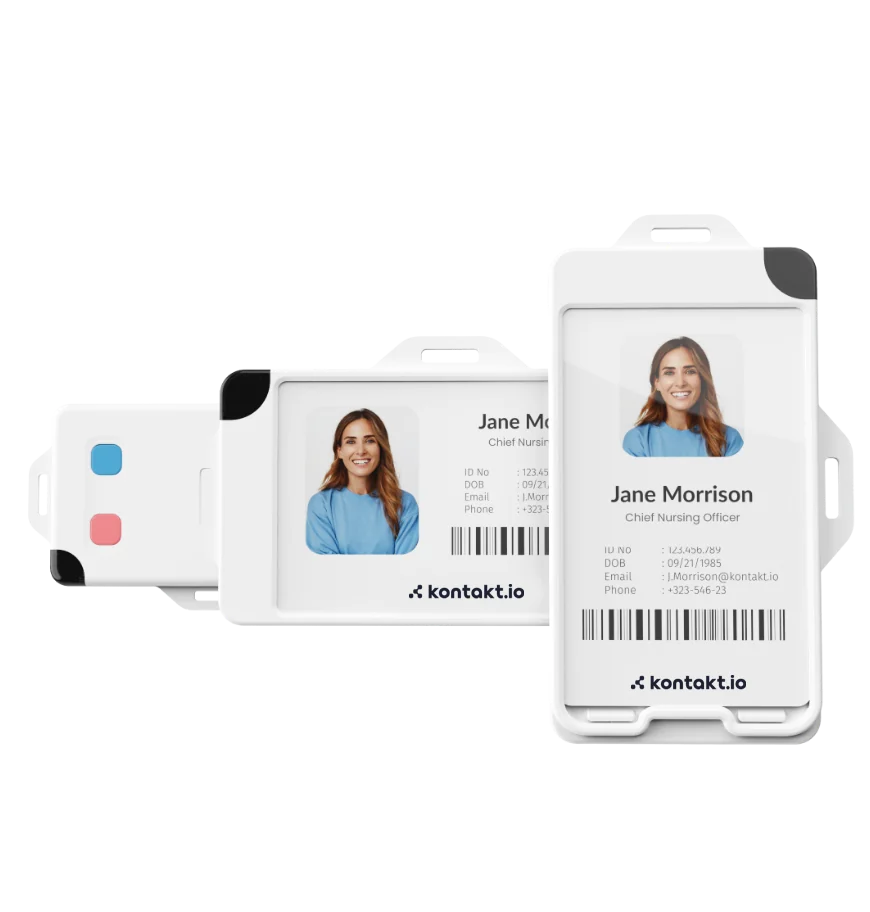
Badges with daily or weekly charging create operational friction and protection gaps when batteries die mid-shift. Minimum acceptable battery life is three years; four years is optimal. Both Smart Badge 3 and Smart Badge 3 Mini deliver up to four years of battery life with IR and factory default configuration.
Integration with Existing Infrastructure
Healthcare duress alert systems RTLS integration must work with your current network rather than requiring forklift replacement. The system should integrate smoothly with existing Wi-Fi, Cisco, Wi-Fi 6, and BLE networks, all cloud-managed for easy updates. This reduces deployment time and capital expenditure.
Audit-Grade Incident Reporting
Every alert must be logged with timestamp, location, responding personnel, and resolution time. This data supports Joint Commission compliance, OSHA documentation requirements, and continuous improvement of security protocols. Analytics should surface patterns by unit, shift, and incident type to enable proactive interventions.
Discreet Wearable Form Factor
The badge must look like a standard ID holder to avoid drawing attacker attention. Lightweight design (under 35 grams) ensures staff actually wear it throughout their shift. Smart Badge 3’s ID-card-shaped form factor attaches naturally to existing badge clips without adding bulk.
Mobile-First Responder Notifications
Alerts must reach responder smartphones, security dispatch consoles, and clinical command boards simultaneously with full identity, location, and timestamp metadata. Nurse duress alert system mobile integration ensures security teams receive push notifications with one-tap navigation to the affected location, cutting response times from minutes to seconds.
Where Duress Technology Is Heading in 2026
The best wireless duress solution for hospital staff safety in 2026 will extend beyond button-press activation to incorporate ambient sensing, predictive analytics, and AI-driven intervention strategies.
Ambient AI Listening
Passive audio recognition of distress cues (raised voices, specific verbal threats, sounds of physical struggle) can trigger automatic alerts without requiring the staff member to press a button. AI models trained on de-identified clinical audio distinguish between normal elevated conversations and genuine threats.
Privacy-preserving implementations process audio locally on edge devices with no recording or storage, analyzing only acoustic patterns rather than speech content.
Biometric Monitoring
Wearable sensors detect physiological stress indicators (elevated heart rate, rapid breathing, stress hormones in sweat) that precede or accompany violent encounters. When biometric baselines exceed pre-defined thresholds, the system sends proactive alerts to security teams who can check on the staff member before an incident escalates.
Next-generation badges will integrate medical-grade sensors that continuously monitor vital signs while maintaining multi-year battery life through advanced low-power chipsets.