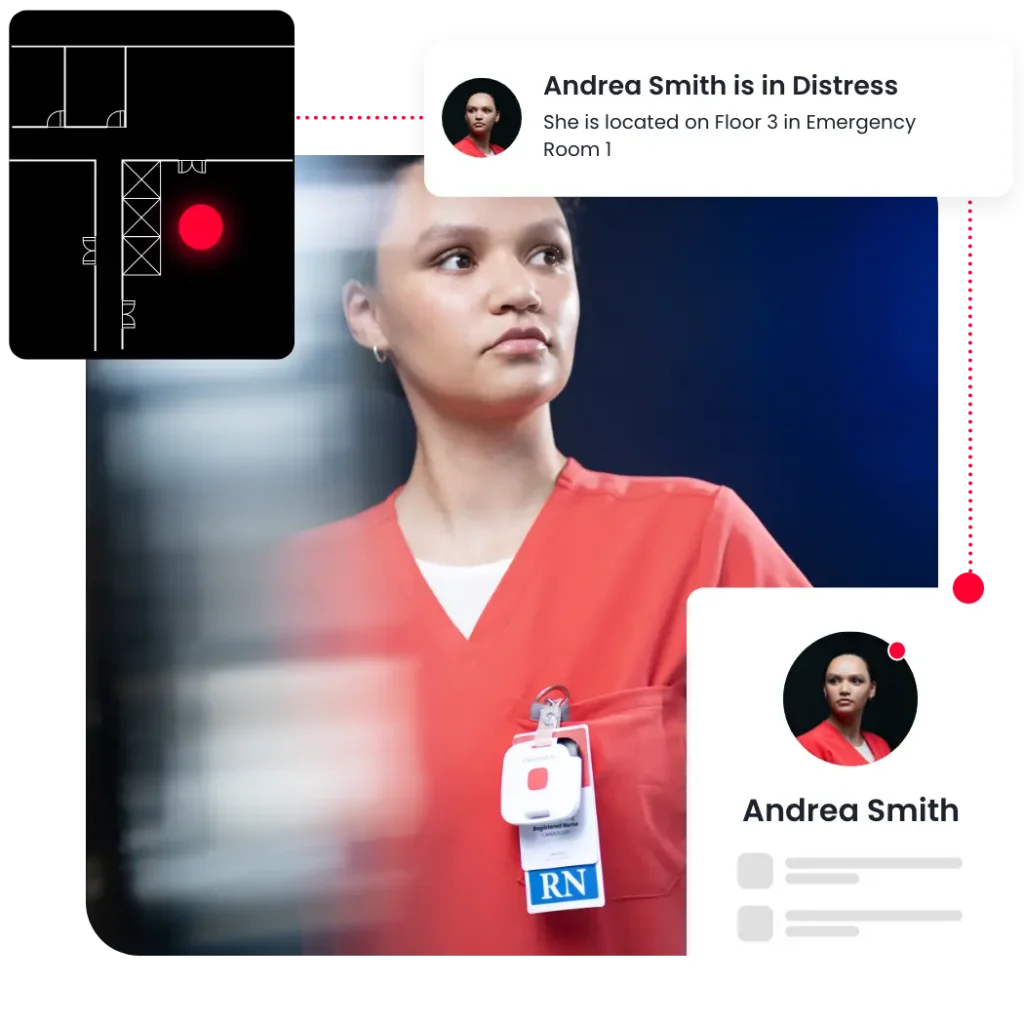
The category that matters most for a hospital-grade decision is the middle two rows. Pure BLE systems estimate location using signal strength, and Bluetooth signals travel through walls, reflect off equipment, and fluctuate with foot traffic, producing the industry’s well-documented “15-foot accuracy” problem: a badge that reports someone in a general area, not a confirmed room. A hybrid approach pairing BLE for real-time transport with infrared for room confirmation closes that gap, because infrared does not pass through walls; if a sensor detects it, the person is confirmed in that room, not an adjacent one.
Kontakt.io’s own architecture documentation puts this at 99.99% room-level accuracy when BLE and infrared are combined, versus roughly 90% for BLE-only deployments with one to five minutes of latency.
A note on network independence: cellular or GPS-based systems are marketed as immune to Wi-Fi outages, since they don’t depend on hospital network infrastructure to transmit an alert, a real advantage during a full network failure. The tradeoff is that GPS and cellular positioning are considerably less reliable indoors, particularly in multi-story concrete buildings, the opposite failure mode from a Wi-Fi-dependent system. Weigh this against your building’s construction and your network’s redundancy, not against a vendor’s marketing claim in either direction.
RTLS duress alarm systems vs hardwired call buttons
Choosing between a Real-Time Location System (RTLS) duress alarm and a hardwired call button comes down to balancing mobility, response speed, and infrastructure costs. While hardwired systems represent the traditional gold standard of fixed reliability, RTLS solutions have become the modern benchmark for dynamic environments like healthcare facilities, behavioral health units, and industrial settings.
| Feature |
RTLS Duress Alarm Systems |
Hardwired Call Buttons |
| Mobility |
High. Wearable badges, pendants, or wristbands move with the employee anywhere on campus. |
Zero. Fixed in a single, stationary location (e.g., under a desk, on a wall). |
| Location Accuracy |
Precise. Pinpoints the exact room, hallway, or coordinates (often within feet). |
Room/Station-Level only. Only indicates which button was pressed, not where the staff member actually is if they moved away from it. |
| Installation & Infrastructure |
Wireless / Hybrid. Utilizes Bluetooth, Wi-Fi, UWB, or RF mesh. Minimal physical disruption, though network mapping is required. |
Hardwired. Requires extensive physical cabling, drilling through walls, and conduit installation. |
| Cost Profile |
Higher initial software/tag investment and ongoing battery/hardware maintenance, but zero wiring costs. |
High labor and material costs for trenching/wiring; minimal ongoing software maintenance. |
| Best Suited For |
Mobile staff, roaming care teams, lone workers, or large campuses. |
Fixed checkout counters, reception desks, pharmacy windows, or cash-handling stations. |
What a Hospital-Grade Duress Alarm System Requires
A system that works in a demo does not automatically work in a 300-bed hospital with concrete walls and a Wi-Fi network built for clinical devices, not security infrastructure. The requirements below separate systems that hold up under real conditions from ones that do not.
- Room-level, deterministic accuracy. The system should confirm which room a staff member is in, not estimate a radius. A responder sent to the wrong room loses valuable seconds in a rapidly escalating situation.
- Silent, covert activation. Per IAHSS Guideline 04.08, a duress alarm is activated covertly; an audible alert at the point of activation can escalate the exact situation the system is meant to defuse.
- Resilience during the emergencies it’s built for. A system dependent entirely on mains power or a single Wi-Fi network fails during the exact conditions, power interruptions, severe weather, that also correlate with elevated risk. Evaluate battery life and failover behavior, not just normal-conditions uptime.
- Privacy-first design. Staff location should be tracked only when an alert is active, not continuously.
- Ligature-resistant hardware in behavioral health units. A wearable designed for a med-surg floor isn’t automatically appropriate for a BH unit.
- Integration depth, not a standalone box. An alert that can’t cancel a nurse-call event, or lives in a separate dashboard from existing security systems, adds a manual step during an emergency.
- Audit-grade analytics. The system should produce activation logs, response times, and location trends that hold up during a Joint Commission survey or post-incident investigation, not just alerts.
Where DIY and Commodity Alternatives Fall Short
A consumer panic-button app, a repurposed walkie-talkie channel, or a personal safety app built for rideshare passengers will not meet the requirements above. The gap isn’t build quality; it’s what the product was designed to solve.
A consumer safety app typically relies on the user’s personal phone and cellular or Wi-Fi connection, with no room-level location layer, no integration into hospital security or nurse-call systems, and no audit trail a compliance team can use. It also depends on staff unlocking a personal device during an active threat, an additional step that uses valuable seconds.
A repurposed radio channel solves communication but not location; a dispatcher hearing an open-channel call for help still has to determine the origins of this call, from hundreds of rooms within a single hospital campus.
None of these substitutes were built against IAHSS’s silent-activation guidance, and none produce the documentation the Joint Commission now expects. The gap is the four-part architecture described above, and shortcuts around any one part reintroduce the failure modes a purpose-built system exists to close.
How Do You Activate a Staff Duress Alert?
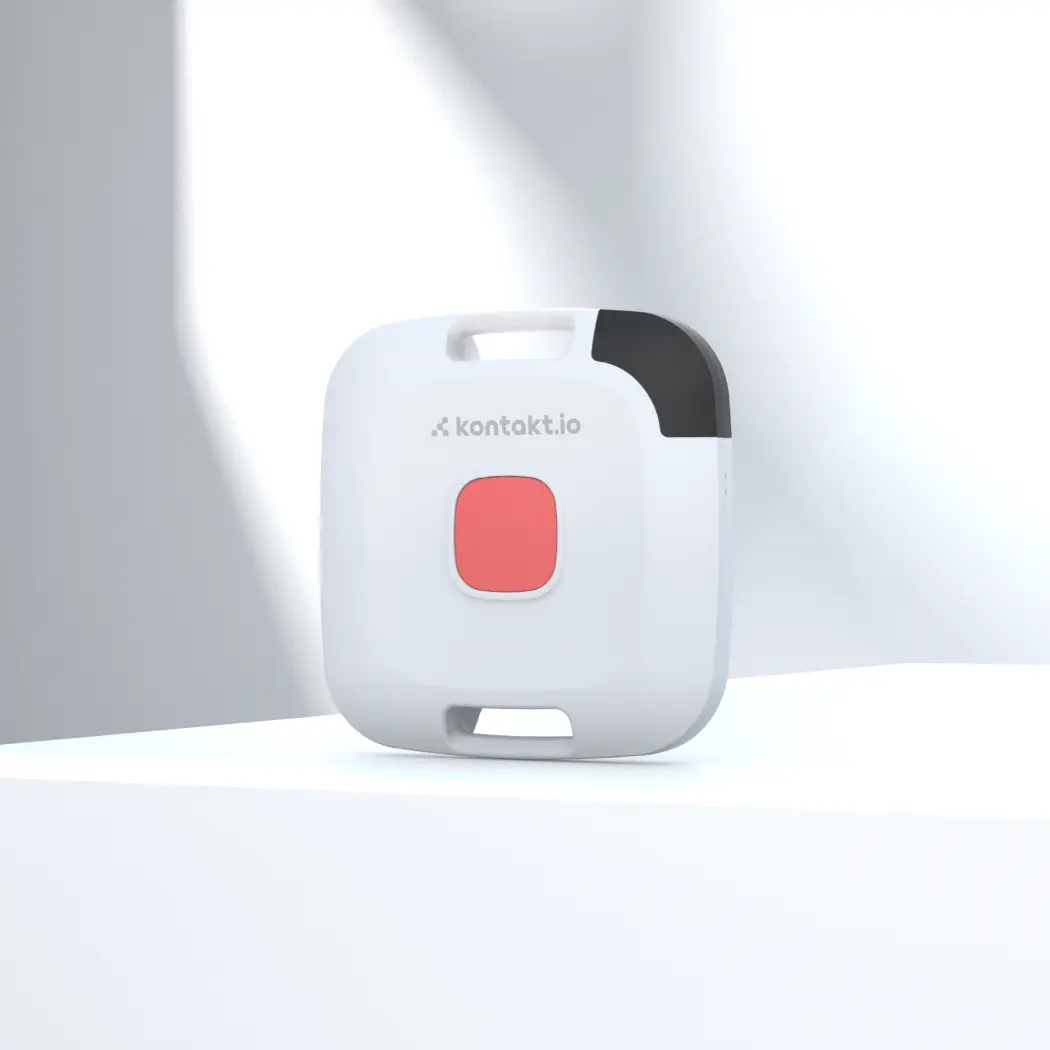
Activation methods vary by device but generally include a single press for a standard alert, a long press or multiple presses to escalate severity, and, on some devices, a pull-cord or fall-detection trigger for staff who can’t reach a button.
The right method depends on the unit: a behavioral health floor and a parking garage present different risks and call for different device form factors.
Requirements and Compliance: What Regulators Expect
Compliance is where a duress alarm system extends beyond a simple security system, and into the realm of documentation and auditing.
OSHA has no dedicated workplace violence standard, but its 2016 guidelines for healthcare workers list panic buttons and personal alarm devices as expected components of a violence prevention program, and it can cite a hospital under the General Duty Clause for a recognized, unaddressed hazard.
The Joint Commission’s standards carry more direct weight: they took effect for hospitals on January 1, 2022, and require a documented program including incident reporting and trend analysis, an annual worksite security risk analysis, and reporting to the governing body, with more than 100 related citations issued since 2022 and a 60-day correction window. These remain the 2022 hospital standards; later phase-ins extended similar requirements to behavioral health and home care settings, not to hospitals.
State law is moving the same direction. New York’s State Senate Bill 5294B requires hospitals and nursing homes to establish a violence prevention program with an annual security assessment that considers alarm and communication systems, plus dedicated security staffing for certain emergency departments.
Illinois considered a narrower bill, SB 1435, that would have required a panic button on every hospital employee’s ID; it stalled in committee and was never enacted, so it shouldn’t factor into any hospital’s compliance planning. Both the enacted and stalled legislation point in the same direction: regulators increasingly expect evidence, not just policy language, that a prevention program is operating.
How to Implement a Duress Alarm System
Implementation succeeds or fails on integration, not installation. The highest-value integration point is nurse call. When a staff badge’s location is confirmed inside a patient room, that same data can automatically cancel a nurse-call event, removing a manual step nurses perform dozens of times per shift.
Rollout should be phased, not facility-wide on day one. Start in the units with the highest documented risk, typically the emergency department and behavioral health, where early wins build the internal case for expansion.
Budget IT time for infrastructure assessment before hardware installation; sparse Wi-Fi access point density in older wings will need denser gateway placement to hit room-level accuracy targets, and finding that out during a pilot is cheaper than finding it out after a system-wide purchase.
Training should include activation drills, not just an orientation email; staff who’ve never practiced using a badge under simulated pressure will hesitate to use it during a real one.
Where Duress Alarm Systems Are Used
Emergency departments and behavioral health units carry the highest documented risk and are where most hospitals deploy first, but duress systems increasingly extend further. Lone or isolated workers, overnight pharmacy staff, environmental services covering a parking structure, home health staff outside a hospital’s four walls, face a different risk profile: no colleague nearby to notice a problem and call for help on their behalf. Location accuracy and integration depth matter just as much, sometimes more, in these settings, since there’s no second person to compensate for a system’s gaps.
Oregon State Hospital’s published Policy 8.035 shows how a real institution codifies this: it requires all personnel with direct patient contact to wear a configured personal mobile transmitter at all times in patient care areas, with the security department operating the monitoring system continuously. That level of specificity, who must wear a device, when, and who monitors it, is what a surveyor or state investigator looks for during a review, and it’s a useful model for any hospital drafting its own policy.
How to Choose a Duress Alarm System Vendor
Start with your building’s constraints, not a vendor’s feature list. A multi-building campus, a facility with older concrete construction, and a single modern tower each demand different answers to the same questions:
- What is your building’s age and construction, and how does that affect Wi-Fi and BLE signal propagation?
- Where are your current wireless dead zones, and does the vendor’s architecture address them specifically, or assume uniform coverage?
- How many buildings, and how far apart, does the system need to cover, and does pricing penalize multi-site deployments?
- What is the vendor’s demonstrated room-level accuracy, and can they show deployment data rather than a lab benchmark?
- Does the system integrate with your specific nurse-call, security, and communications vendors by name, or does it require a separate dashboard?
- What does the system produce for compliance documentation, and has it held up during an actual Joint Commission survey at a reference customer?
- What is the total cost of ownership across hardware, software, installation labor, and multi-year support, not just the per-badge list price?
A vendor who answers these with specifics, rather than general reassurances, is telling you something important about how their system performs in the field.
ROI and Total Cost of Ownership
The financial case rests on three categories of return: incident reduction, response time, and compliance-risk avoidance. The 2025 American Hospital Association study on the cost of violence to U.S. hospitals found hospitals spent an estimated $18.27 billion managing workplace violence in 2023, up from $2.7 billion in 2016, with $14.65 billion going to post-event costs like treating violence-related injuries. A system that shortens response time and enables earlier intervention works directly against the largest driver in that estimate.
Compliance-risk avoidance is the category buyers most often overlook. A hospital cited by the Joint Commission for a workplace violence deficiency faces a 60-day correction window and the cost of building documentation retroactively, work a system with audit-grade reporting does continuously as a byproduct of normal operation.
Staff retention is the harder-to-quantify factor: a security response system nurses trust is one input into a broader safety perception that affects turnover, and nursing turnover costs are well documented to run into six figures per departure. None of these returns show up on a single line item, which is why they belong in the vendor conversation rather than the procurement spreadsheet alone.
A duress alarm system is the front line of your workplace violence program, but it’s one piece of a broader safety strategy. See how Kontakt.io’s Staff Safe duress alarm system applies room-level location certainty to staff safety.