From Finding to Doing: Why Hospitals Need To Go Beyond RTLS
It’s 11 AM on a Tuesday. Do you know where your patients are? What about your nurses?
Today, the most common narrative is that hospitals are drowning in data, but the opposite is true: hospitals simultaneously have too much of the wrong data, and not enough of the insights that actually drive decisions and move the needle on patient outcomes and hospital efficiency.
Key takeaways
- Hospitals don’t lack data; instead, they lack the connection between data sources that turns raw signals into operational decisions.
- RTLS is a foundation, not a solution; the orchestration layer built on top of it is what produces measurable results.
- Health systems with existing RTLS deployments are closer to operational intelligence than they may realize; the infrastructure is already there.
Specifically, these insights concern patients and employees. For patients, this missing data can cover anything from location to care progression. For instance, patients may have to wait hours for CT scans, even if the machines are open, simply because an operations team has no real-time data on where individual patients are within their care journey; therefore, they cannot prioritize them for procedures like CT scans.
These delays add up: one study of 52 New York hospitals estimated that discharge delays averaged two weeks, and cost a total of $169 million.
In addition to real-time data on patients, hospitals also need lifetime insights on clinical and support staff such as nurses, nursing assistants, and supply chain technicians. These lifetime insights consist of metrics like bedside time, utilization patterns, and response history, and play a crucial role in understanding how employees spend their time, and in optimizing workflows: what procedures can be done differently or which processes can be automated.
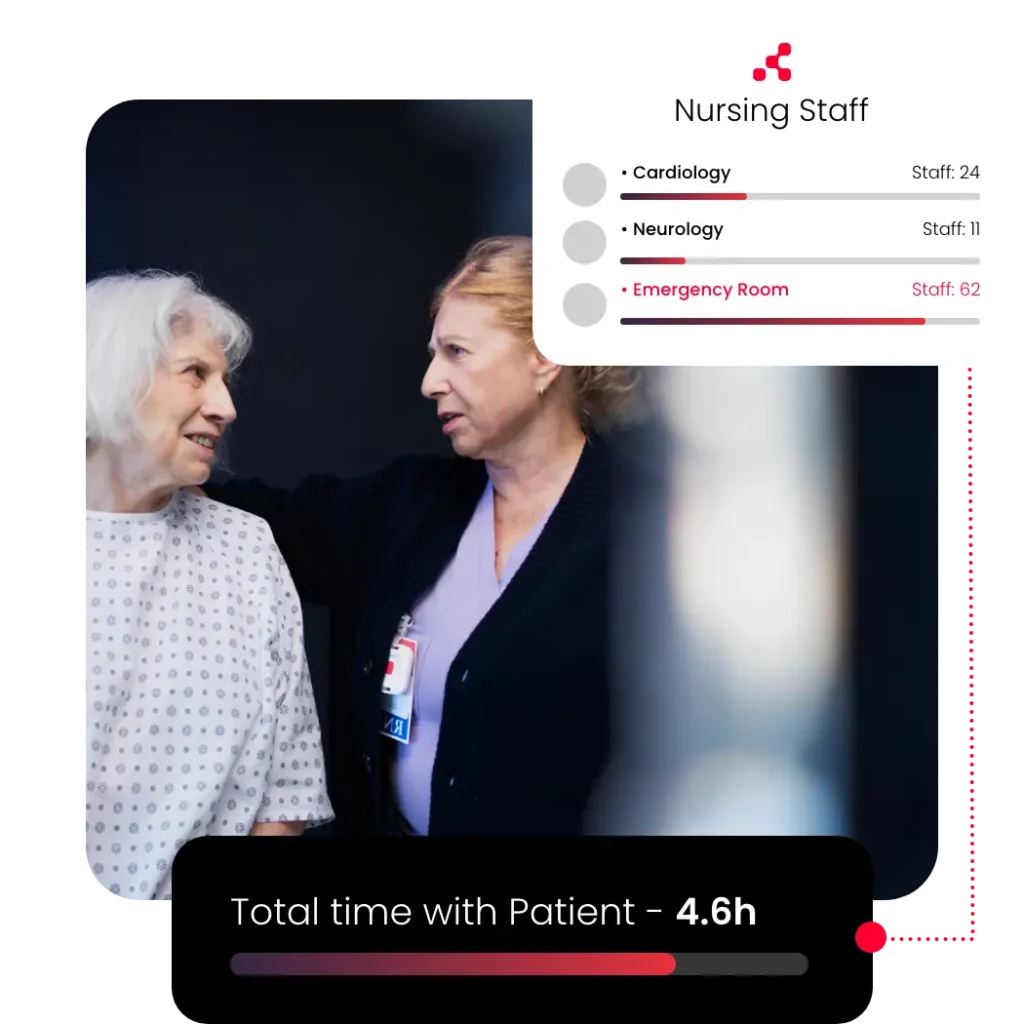
Without lifetime insights, hospitals cannot carry out root cause analysis to improve their operations. For example, when ED boarding occurs, charge nurses or care coordinators have to work backwards to uncover the true cause of the problem; there are no other beds elsewhere, but the real question is why. To get to the right answer, leaders and teams need a longitudinal data set that can show where breakdown actually occurs: inefficient patient discharge workflows and slow room turnaround times.

What Are the Limitations of RTLS?
Real-time location systems (RTLS) were supposed to solve these issues by providing a steady stream of up-to-date information on every aspect of hospital operations, from equipment locations and statuses to patient care pathways. But as hospitals grew larger and more complex, with vastly more devices, patients, caregivers, rooms, and facilities, RTLS has been a solution shoehorned to fill an operational gap that it was never designed to address.
RTLS is also a starting point, and not the end goal. It provides raw data, such as the last known location of a wound vac or the last room that a nurse visited, at regular intervals. But compounded across a large hospital campus, this data can quickly become overwhelming.
As an example, assume that a hospital contains thirty rooms in a single wing, with two patients per room and twenty nurses within the wing. If staff badges and patient tags generate one data point every two seconds, then that equates to 40 data points per second, 144,000 per hour, and more than 3.5 million per day, all for a single hospital wing. Multiplied across an entire campus, data volumes will grow exponentially, to the point where it is impossible for any human to parse or make sense of.
What Are the Shortfalls of Traditional RTLS?
To complicate matters, legacy RTLS providers were designed for simpler operating environments, so their devices and processes are not only difficult to scale, integrate, and maintain, but also unreliable and inaccurate. This forces hospital IT teams to run extra Ethernet cabling, manually update firmware, or troubleshoot individual devices (and their readings). Traditional RTLS providers also aren’t natively compatible with existing hospital systems, like electronic health records (EHRs), requiring workarounds (and more work) from IT teams.
In addition, many RTLS services were not engineered for the cloud; instead, they store data on on-premises servers and obsolete data architectures, making scaling, analysis, and other functions difficult. For example, if a leader wants to pull data for insights, they’ll have to engage a professional services team, pay extra, and wait months. Analyzing data from multiple hospitals will also be challenging, expensive, and tedious: professional services teams will have to pull data from each hospital campus, join them together, and normalize them for analysis. This process could take weeks and produce a snapshot that is already out of date by the time it reaches leaders.
How Orchestration Builds on Location
By adding an orchestration layer, hospitals can translate raw data from RTLS sensors and EHRs into insights and real-time interventions that can put the right equipment, staff, and information into the right place at the right time.
Take supply and demand, which for hospitals, encompasses devices, rooms, and people. Orchestration can combine location data and historical context with demand. If a patient enters the ED with measles, the system draws on previous experience to identify which staff can be flexed to that unit, which equipment needs to be routed, and what the downstream operational implications are across the rest of the floor. What could have been an unpredictable event can quickly be handled, with minimal disruption to existing operations.
An important distinction is insights versus data: a data point could be a nurse location at a specific time of day, but an insight is how much of that nurse’s shift is wasted on hunting for equipment or filling out paperwork, rather than spent on patient care. Importantly, these insights can only be extracted by the orchestration layer, simply because the sheer volume of data is unmanageable for human analysts.
These insights could take the form of flagging a patient awaiting transfer, who has been in the ED for three hours without a bed assignment; or a notification to a care team that their high-acuity patient has not had a clinician visit in the last ninety minutes. When these insights reach a charge nurse or operations leader in time to act on it, workflows improve, clinician time is recovered, and patients move through their care journey faster.
How AI Improves Hospital and Patient Workflows
AIs can also rapidly scale data analysis and insight creation. For example, instead of taking time and money to conduct a time-motion study to see where workflows are failing or how clinicians are getting bogged down, hospital leaders can just use AI to ingest and analyze RTLS and EHR data. The orchestration layer does not just route information to the right people; it also makes analysis that once required weeks of manual work available in minutes.
These gains scale across departments. After an orchestration layer ingests real-time data (from RTLS sensors) and clinical context (from EHRs), leaders can also get answers to a broader group of questions, including:
- Which devices should a supply chain tech prioritize?
- Which patients should get a CT scan first?
- How many hand hygiene events were recorded this quarter, and does it have any impact on the rate of hospital-acquired infections?
These questions cannot be answered by any single system (such as EHRs or RTLS sensors) in isolation. Instead, they require a unified data layer that can pinpoint where patients, staff, and equipment are, and further, enrich all three with clinical answers. With an AI-powered orchestration layer, leaders at all levels of a health system can finally have a full operational picture: a single, real-time view of what is happening, and what needs to be done next.
For leaders, the value of any individual data source (such as EHRs or RTLS sensors) is limited by how well it connects to everything else. A nurse badge that generates 30 data events per minute is only useful if something downstream can interpret these events, correlate them with patient acuity and room status, and surface the high-impact action to take.
Conclusion
Rather than asking whether hospitals have enough data, leaders need to determine whether this data is connected to the right systems, so it can create insights and action. If the answer is no, then the problem lies in the absence of a layer that can hold them together.
That is what an orchestration layer does. Without one, hospitals which have invested heavily in point solutions still find themselves making operational decisions manually, on incomplete information, hours after the moment when acting would have made a difference. If patients are still waiting for beds or procedures while nurses are still frantically searching for equipment, the root cause of these challenges is a failure of connection: the right insights and tasks simply don’t make it to the right person at the right time.
If hospitals want to solve this problem, their teams cannot continue to rely on EHRs updated every three hours; on manual procedures like calling the charge nurse to verify room numbers; or more sensors or point solutions. Instead, they need a layer that ingests data, converts them into insights and interventions, and orchestrates operations at scale.