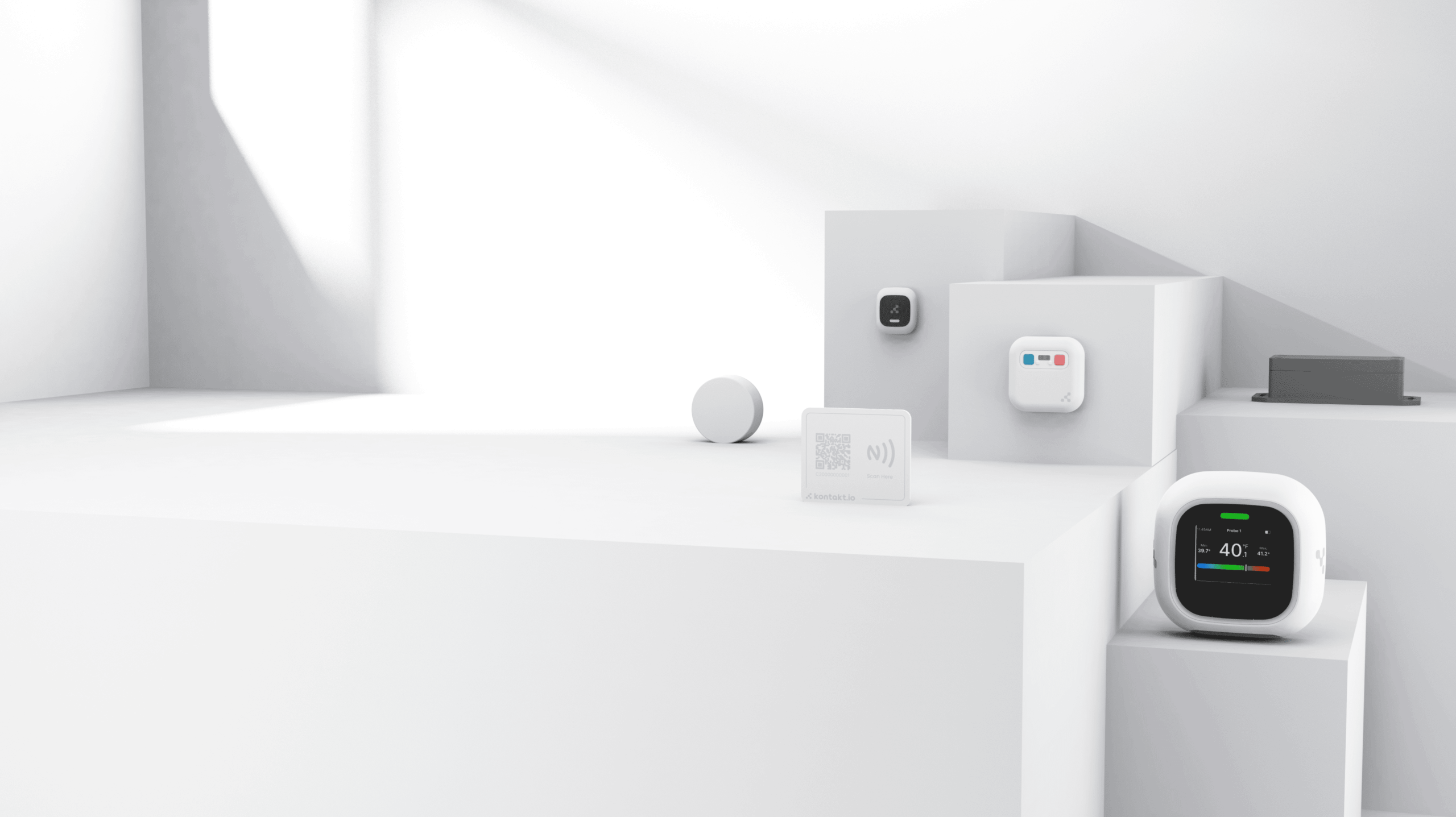
What RTLS is in hospital asset management?
RTLS (Real-Time Location System) in hospital asset management is a technology that continuously tracks the location and status of medical equipment, staff, and sometimes patients in real time. It helps hospitals know what assets they have, where they are, and whether they’re available.
For asset management, the key assets are things like IV pumps, wheelchairs, infusion stands, telemetry devices, ventilators, and portable monitors. Each gets a small battery-powered tag. The RTLS infrastructure detects those tags and reports their position to a software platform that shows you where every asset is right now, where it was, and whether it’s available, in use, or sitting idle.
Here’s what separates useful RTLS from basic tracking: the location data becomes the foundation for workflow automation. Who cares where your IV pump is if that information just sits in a dashboard? The real value comes when the system turns that location into action: an alert that a device hasn’t been cleaned and returned, a dispatch recommendation that routes the nearest available pump to a unit in need, or a utilization report that tells procurement they don’t need to rent 20 more pumps next quarter.
Asset management stakeholders care about three things in particular: procurement and rental cost control, biomedical workflows (maintenance, inspection, audit readiness), and equipment availability at the point of care. RTLS addresses all three, but only if the location data is accurate and timely enough to trust.
How RTLS-powered asset management works in hospitals
You don’t need to understand radio physics to run RTLS in your hospital. But knowing the basic flow helps you evaluate whether a vendor’s architecture will actually work in a clinical environment.
- Tags broadcast identity. Small BLE beacons or tags attached to equipment transmit a unique identifier via radio signal at regular intervals.
- Receivers detect the signal. Gateways or access points installed throughout the facility pick up those broadcasts. Coverage density determines how precisely the system can resolve location.
- The location engine estimates position. Software processes the signals from multiple receivers and calculates where the tag is, using one of several measurement methods.
- The platform renders an asset state. Raw position data becomes something actionable: “IV pump #4421 is in Room 312, available,” or “Wheelchair #88 hasn’t moved from the supply corridor in 4 days.”
What’s under the hood: RSSI, AoA, and ToF
Three main measurement approaches exist in RTLS systems, and the differences matter in a hospital setting:
- RSSI (Received Signal Strength Indicator): Estimates distance based on signal strength. It’s low cost and widely supported, but in clinical environments, RSSI is prone to multipath and interference from walls, metal equipment, and human bodies. That typically yields zone-level accuracy rather than strict room boundaries – good enough for broad visibility, but problematic when you need to know whether a device is in Room 412 or Room 414.
- AoA (Angle of Arrival): Uses antenna arrays to determine the direction a signal arrives from, enabling more precise positioning. It requires compatible hardware infrastructure but delivers tighter accuracy, especially in dense clinical layouts.
- ToF (Time of Flight): Measures the actual travel time of a radio signal between tag and receiver. Used in UWB-based RTLS systems, ToF can achieve sub-meter accuracy – but at a higher infrastructure cost.
Why Choose BLE Beacons for Indoor RTLS Systems?
Kontakt.io takes a different approach: BLE combined with IR (infrared) Beam technology. When an asset tag enters a room, an IR Beam sensor mounted in the doorway or ceiling captures a deterministic room-entry event – no estimation, no probability. The location engine assigns the tag to that room with certainty, delivering room-level accuracy with under 5 seconds of latency. Compare that to BLE-only approaches, which can deliver 15-30 ft accuracy with 3-60 second latency windows. In a real clinical workflow, that gap is significant. A 15-foot radius puts you anywhere across two or three rooms on a typical floor.
How does RTLS improve hospital asset management and reduce equipment rental costs
RTLS improves hospital asset management by turning location data into workflow automation, not by displaying a map. Location alone answers “where is it”; the value arrives when the system converts that position into an action. Asset management stakeholders care about three outcomes in particular: procurement and rental cost control, biomedical workflows, and equipment availability at the point of care.
Knowing where an asset is located is the starting point. Here’s what you can actually do with that data:
- Real-time visibility and historical audit trail. Every asset has a current location, a status (in use, available, dirty/needs cleaning, in biomed), and a movement history. This replaces the clipboard-and-memory system that most hospitals still use for physical rounds.
- Inventory accuracy and right-sizing. The Veterans Health Administration facility in Kankakee, IL, struggled with misplaced IV pumps, over-purchasing, and staff inefficiency before deploying Kontakt.io’s BLE RTLS. As Greg Merrill, Program Analyst at the VA, put it: “Having better insights into our real inventory status for various pieces of equipment means we can make better procurement decisions and not over-purchase things that we already have enough of.” The facility reduced equipment search times and built a foundation for future use cases including patient wayfinding.
- Rental cost control. One of the most direct RTLS ROI drivers. When you can see that 40% of your IV pump fleet sits idle in a storage corridor, you stop renting. Hospitals using RTLS have achieved up to an 80% reduction in equipment rentals and a 30% improvement in utilization. (based on Kontakt.io implementations)
- Loss prevention and movement controls. Tags trigger alerts when assets cross defined perimeters or leave a unit unscheduled. This reduces equipment shrinkage and catches unplanned asset migration between departments before the asset is “lost.”
- Biomedical workflow support. RTLS captures dwell time and usage patterns per device. Biomed teams can pull actual utilization data to inform preventive maintenance scheduling, verify inspection compliance, and prepare for accreditation audits without manual rounds. This is a significant workflow improvement for teams managing thousands of devices.
- Operational predictability. This is where Kontakt.io’s platform goes beyond visibility. The location engine feeds an agentic AI layer that forecasts demand, stages assets in advance, and routes equipment in real time. You’re not just seeing where your IV pumps are; the system is predicting where they need to be in the next two hours based on census, admissions, and discharge patterns. That’s the difference between a tracking tool and an operations platform.
How do you measure RTLS ROI for hospital asset management?
You measure RTLS ROI for assets management in three steps: establish baselines before you deploy, define your ROI calculation categories, then run a 30/60/90-day measurement playbook. The primary drivers are rental reduction, labor hours recovered from equipment search, and replacement costs avoided. Vague ROI claims are everywhere in this category; the framework below is the one you can actually use.
Step 1: Establish your baselines before you deploy
You can’t measure improvement without a starting point. Before deployment, document:
- Average equipment search time per shift (survey nursing staff; even rough estimates reveal scale)
- Monthly rental spend on equipment categories you plan to track
- Utilization rate for key asset classes (how many of your 80 IV pumps are actually in active use vs. parked, lost, or idle at any given time?)
- “Unable to locate” incident volume logged by biomed or nursing
- Staff overtime attributable to equipment delays or searches
Step 2: Define your ROI calculation categories
Step 3: 30/60/90-day measurement playbook
- Days 1-30 (Ops and Biomed): Confirm tag coverage and location accuracy. Run baseline vs. live utilization reports. Identify the 5-10 highest-value asset classes to focus on first.
- Days 31-60 (Materials/Procurement): Compare rental orders to pre-deployment baseline. Calculate rental cost delta. Identify any asset classes where visibility reveals overstock or understock.
- Days 61-90 (All stakeholders): Measure staff search time via shift surveys. Pull biomed PM compliance data. Quantify replacement purchases avoided. Calculate aggregate ROI across all categories and extrapolate annualized savings.
Hospitals using AI-enhanced RTLS like Kontakt.io’s platform typically see payback within the first few months, driven primarily by rental reduction and labor efficiency. The 30/60/90 framework ensures you’re capturing the numbers needed to justify expansion to additional use cases or facilities.
Implementation and adoption: what changes for IT and for end users
Deployment isn’t just a technical exercise. It’s a change management exercise too, and most RTLS rollouts that underperform do so because of adoption, not technology.
Deployment steps
- Site survey and infrastructure mapping. Identify receiver placement, IR Beam sensor locations (for room-level certainty), and any coverage gaps. Existing BLE-capable access points (including Cisco Catalyst 91xx series) can often be leveraged, which reduces infrastructure cost significantly.
- Tag assignment and asset onboarding. Tags are pre-programmed and attached to tracked assets. With Kontakt.io, all BLE beacons and paper tags are included at a flat rate per licensed bed, so this step doesn’t require separate procurement.
- Location mapping and calibration. The location engine is configured to the facility floor plan. Room boundaries are mapped; the ML-based engine resolves room-ID/matrix cell logic rather than XY coordinates, which is more reliable in complex clinical floor layouts.
- Integration with existing systems. RTLS data should connect to your asset management workflows, CMMS (computerized maintenance management system), and where applicable, EHR-adjacent operations. Kontakt.io’s Epic integration, available through the Epic Showroom Toolbox, connects RTLS data to care orchestration workflows for patient, staff, and device management.
- Go-live and monitoring. Confirm coverage, review early alerts and location reports, and identify any floor areas with ambiguous readings before rolling out to end users.
What changes for clinical staff and biomed teams
For nurses and clinical staff, the change is intentionally minimal. They get a dashboard or mobile view showing where their equipment is. Alerts come to them when an asset is needed or when a device has been flagged. The goal is to replace the search with a lookup that takes under 30 seconds.
For biomed, the change is more significant and more positive. Maintenance rounds that required physically walking each floor to locate assets for inspection become database queries. Utilization data supports PM scheduling. Audit preparation becomes a report export instead of a manual count.
The single most important adoption factor: the location data has to be accurate. If staff check the system and the pump shown in Room 312 is actually in Room 314, they stop trusting it within days. Room-level certainty isn’t a marketing claim; it’s the threshold below which adoption collapses.
Privacy, security, and compliance considerations
This section often gets skipped in RTLS buying conversations. It shouldn’t.
Asset tracking vs. staff and patient location: a meaningful distinction
Tracking an IV pump raises no privacy concerns. The device has no civil rights. But when RTLS systems extend to staff badges or patient wristbands (which many hospitals eventually want), the data becomes sensitive. Per guidance from mgm-solutions.com (“Turning Location Data Into Actionable Intelligence for Hospitals”), RTLS location data can become Protected Health Information (PHI) when it links an individual’s identity or care status to their location within a hospital context.
The practical implication: even a system deployed primarily for asset management can touch PHI if it’s also used to infer where patients or specific staff are located. That brings HIPAA into scope.
HIPAA and RTLS: what’s actually required
The HIPAA Security Rule, as described by HHS, defines the confidentiality requirement as ensuring electronic information is not made available or disclosed to unauthorized persons. For RTLS, that means:
- Access controls: who can query location data, especially if it includes staff or patient location
- Encryption in transit and at rest: location data transmitted between tags, gateways, and the cloud platform should be encrypted
- Audit logging: who accessed what data and when
- Business Associate Agreements (BAAs): your RTLS vendor should execute a BAA if any PHI flows through their platform
Kontakt.io’s platform is SOC II and HIPAA-secured. For occupancy and patient flow use cases using Portal Beam sensors, the on-device CNN occupancy model processes thermal imaging locally and discards raw data before cloud transmission, a privacy-by-design architecture that avoids transmitting identifiable imagery.