
Transforming Hospital Staff Tracking with Bluetooth Badges
Hospital staff tracking used to mean a whiteboard, a pager, and a charge nurse with a good memory, but manual processes can’t scale.
Technology for locating and tracking employees, visitors, and other occupants of any sizable facility is now recognized as a powerful tool for increasing safety, responding to emergencies, enabling more effective communication, and improving operational efficiency. Few facility types stand to benefit more than hospitals: psychiatric institutions, community and teaching hospitals, long-term care facilities, and health systems operating across multiple campuses.
Before we get into it, here’s what this article covers:
- What hospital staff tracking actually is — and why the older definitions no longer hold.
- How RTLS and BLE badges work together to deliver real-time staff location.
- Four use cases that matter most: employee badge tracking, nurse location, staff duress, and asset management.
- What room-level certainty means — and why it determines whether a tracking system can automate workflows or just report positions.
- What to ask a vendor before you buy.
The operational case is straightforward: staff who can’t be found can’t be deployed. When a nurse spends four minutes locating a colleague, or security responds to a duress alert without knowing where the incident is occurring, the system has failed before anyone has made a decision.
Real-time location changes that equation.
What is hospital staff tracking?
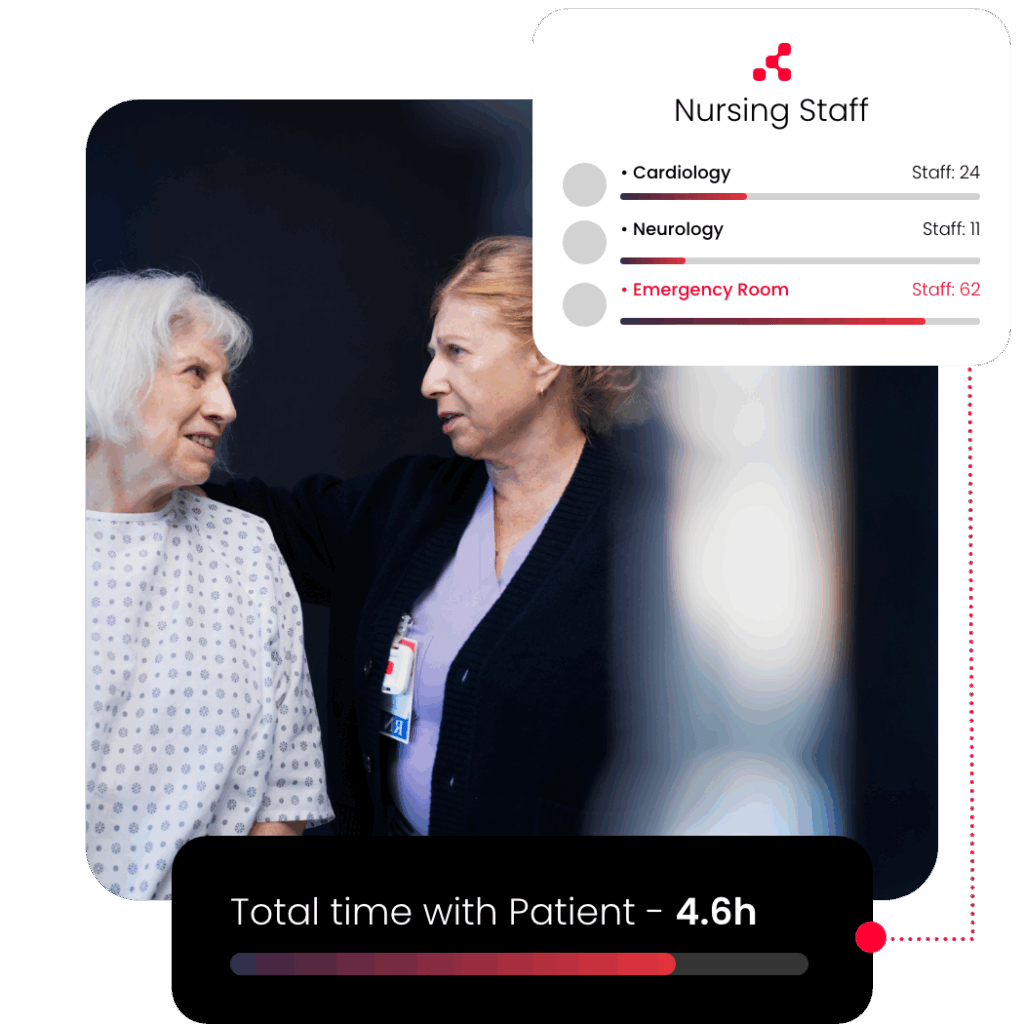
Hospital staff tracking is the continuous, automated monitoring of staff location within a healthcare facility using wearable devices and a connected location infrastructure. Unlike manual check-ins or badge swipes at fixed points, a real-time RTLS badge tracking system knows where every tagged staff member is at any moment: updated in seconds, visible on a dashboard, and actionable within the workflows that depend on that information.
The technology that makes this possible is a Real-Time Location System (RTLS), a combination of wearable RTLS badges or smart badges, fixed infrastructure (gateways, access points, or room sensors), and cloud-based software that processes location signals and surfaces them as usable data.
While healthcare personnel may have privacy concerns, staff tracking is not a form of surveillance. Instead, its purpose is operational: getting the right person to the right place faster, protecting staff when situations escalate, and capturing the workflow data that managers currently have to guess at.
How RTLS staff tracking works: badges and gateways
BLE Smart Badges are worn as part of the standard uniform (typically clipped to an ID badge holder) and continuously broadcast a signal picked up by fixed infrastructure installed throughout the hospital. That infrastructure can take several forms: BLE-enabled Wi-Fi access points, dedicated portal light gateways, or room-level beam sensors. The combination determines how precisely the badge tracking system knows where someone is.
The Bluetooth beacon healthcare tracking solution is cloud-based software for tracking staff members, patients, and assets in real-time. It helps healthcare administrators and managers improve in-patient safety, serviceability, and hospital operations. Using the software alongside RTLS beacon badges and gateway devices allows accurate tracking, attendance and security monitoring, and safe facility operation. The system can be accessed from desktop or mobile devices by authorized staff from any point in the facility.
The distinction between zone-level and room-level accuracy matters more than it might appear. A system that knows a staff member is “somewhere on the third floor” can display a dot on a map. However, a system that knows they are in Room 312 can cancel a nurse call automatically, trigger a hand hygiene prompt at room entry, or route a staff duress response to the correct location in under ten seconds. Kontakt.io’s BLE and infrared (IR) Beam solution delivers 99.99% room-level certainty.
This is a meaningful difference when seconds count (such as during a security incident), or when the workflows depending on that data are clinical (such as nurse call cancellation, duress routing, infection control); in order to be effective, such workflows are contingent on precise, room-level locations.

Employee badge tracking: efficiency across the whole facility
With continuous employee badge tracking on gateway monitoring, tasks as simple as recording attendance and as complex as finding and summoning physicians, nurses, and other staff to a patient room, the emergency room, or any surgical or laboratory suite are easier than ever. They no longer require a search, a page, a phone call, or any combination of the above.
With wristbands or badges, the RTLS badge system automatically registers every time a tag holder enters or exits the facility or a specific area within it. Any authorized staff member can locate and reach colleagues at their current locations. For example, there is no longer any need to guess when a staff member heading for the surgical suite or the ED will arrive, as they can be located via their badge.
Beyond individual searches, employee badge tracking generates workflow data that most hospitals currently cannot access. Time spent in patient rooms, movement patterns between departments, frequency of rounding, response times to calls are all measurable by role, unit, and shift. This data changes how charge nurses allocate assignments, how facilities managers plan staffing, and how clinical engineers account for their team’s activity.
In large or multi-building facilities, the value scales. Staff working in parking structures, ambulance bays, or satellite buildings remain visible and reachable on the same healthcare personnel tracking platform as staff inside the main hospital.
Nurse tracking and real-time locating
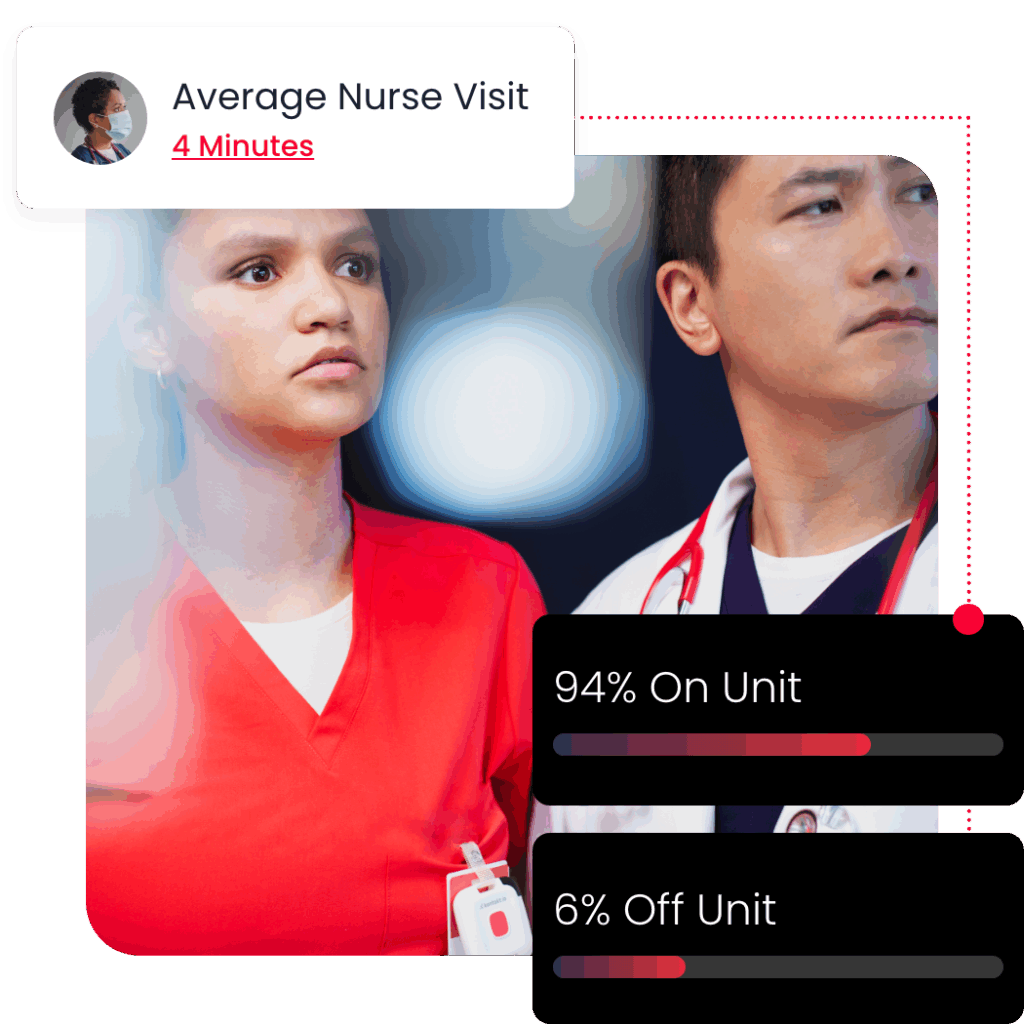
Among hospital employees, nurses likely have the most time pressure, and are also most likely to be asked to be in two places at once. Real-time nurse tracking addresses both problems.
When a patient triggers a nurse call, the system can identify the nearest available nurse by room location and route the notification directly to them, rather than broadcasting to everyone on the floor. When a hospitalist is doing rounds, the nurse tracking badge logs time in each patient room automatically, eliminating manual documentation and providing billing-grade timestamps. When a behavioral health unit needs to verify that a patient has been checked on every fifteen minutes, the system confirms it without having humans write down times and notes on a clipboard.
Rounding management is one of the more immediate operational wins. Kontakt.io’s platform logs how many times a team visited a department, how long they spent there, and the interval between visits automatically, using the same RTLS badge infrastructure that supports safety and asset use cases. For nursing leadership, that data replaces assumptions with a record.
Nurse call cancellation is another workflow that room-level certainty unlocks. Kontakt.io integrates with Hillrom, Rauland, and Ascom nurse call systems to cancel calls automatically when staff members enter the patient room, reducing alarm fatigue without changing the nurse’s behavior at all.
Staff duress and panic-button safety
Workplace violence in healthcare is commonplace. Studies consistently show that hospital staff (particularly nurses) experience elevated rates of physical assault, with many reporting specific units, shifts, or times of day as unsafe. A staff safety system built on a wearable RTLS badge with an integrated panic button is a direct response to that reality.
Kontakt.io’s Smart Badges include an integrated staff duress button that staff can activate discreetly with a single press (or a triple press, depending on hospital preferences) triggering an immediate alert that includes who pressed the button and exactly where they are. The badge provides haptic feedback, so the staff member knows the alert has been sent without any visible or audible alerts. As the situation evolves, the staff safety system continues tracking the staff member’s movement in real time, giving security a live view of a dynamic incident rather than a static starting point.
The difference between a panic button and a staff safety system is what happens after the press. A standalone panic button alerts, but a location-aware RTLS badge system routes, identifying the nearest trained responder, providing room-level context, and surfacing behavioral risk flags if they exist.
At North Georgia Health System, Kontakt.io enabled silent staff duress alerts generating nearly 6.9 billion location events per day, with coordinated responses triggered in seconds across 10,000 caregivers and 950 patient beds.
At Genesis HealthCare System, response times moved from minutes to seconds after deployment in high-risk units, with security able to intervene before incidents escalated.
Asset and compliance use cases
Studies show that the significant loss or misplacement of expensive equipment and instruments has forced some hospitals to maintain larger inventories of owned or rented equipment simply to ensure availability when needed. Staff time is regularly spent searching for equipment. The same RTLS badge infrastructure used for wireless medical staff locating tags all such assets, such as wheelchairs, infusion pumps, portable monitors, so they can be located immediately from any gateway station.
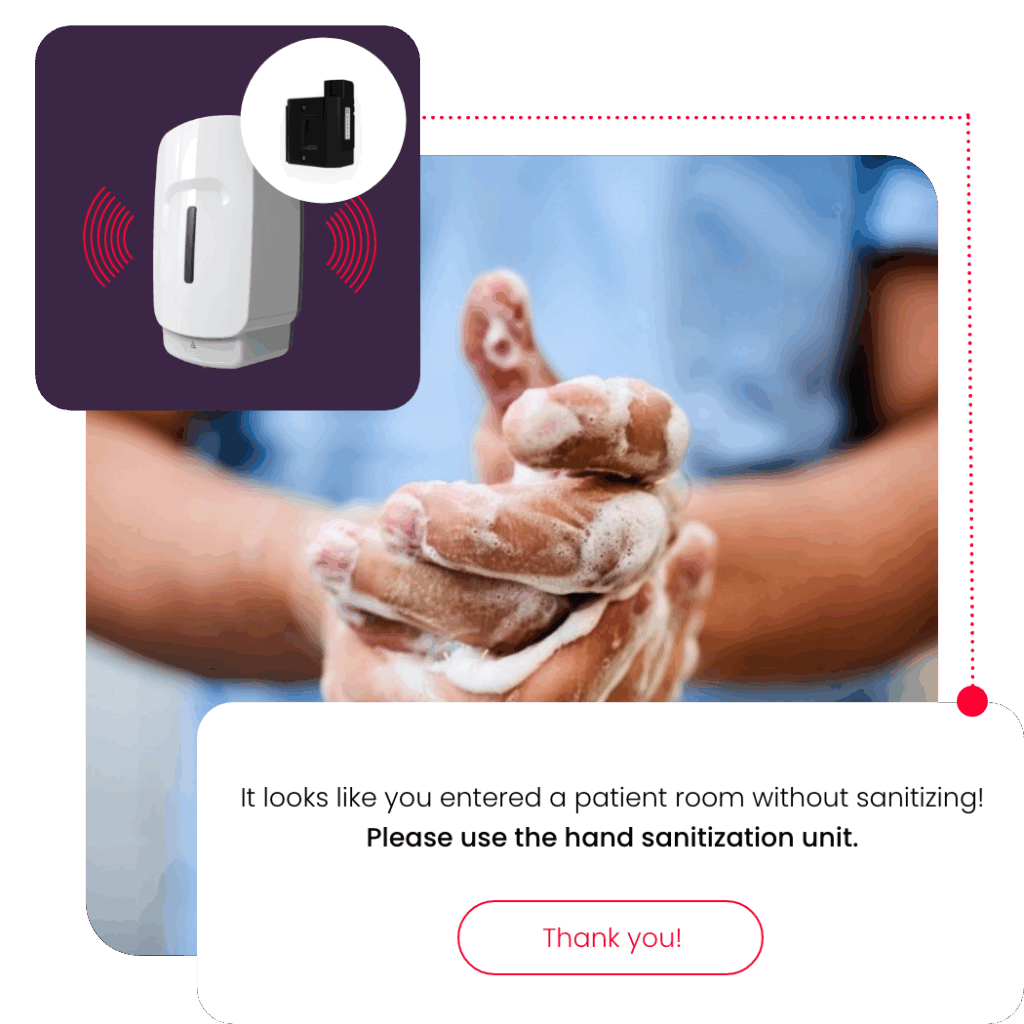
The same badge tracking system that locates staff also enables compliance automation. Hand hygiene monitoring uses room sensors to detect when a badge-wearing staff member is near a dispenser at the point of room entry or exit, attributing dispense events to specific individuals and calculating compliance rates by role, unit, and time of day. This removes the observer effect that undermines manual auditing.
For medication inventory, temperature monitoring, and access control to restricted areas, the same network handles what previously required separate systems and manual checks. Responsibility for routine but necessary compliance tasks is reduced when the infrastructure does the counting, logging, and alerting automatically. Staff are freed to focus on the work those compliance tasks are designed to protect.
