How to Build Clinician Trust in the AI for Healthcare Operations
Healthcare workers and technology vendors have a trust gap. While clinicians and technicians worry that AIs will override their judgment and experience, or replace them outright, technology vendors wonder why health systems don’t adopt AIs which promise simpler operations, streamlined schedules, and less stress.
It is a familiar story in healthcare tech: when EHRs were introduced, they were sold as the answer — a system that would automate documentation and save clinicians time. In practice, they created more work. Documentation demands grew, In Basket volume climbed, and now a new wave of tech solutions is being built just to manage the burden the last wave created.
To further exacerbate skepticism around adopting technology, tech is often rolled out without proper support or introduction. These adoption failures often have less to do with the solution itself than with how it was rolled out: in large implementations, it’s easy to focus so much on getting the technology, timeline, and project plan right that education and training fall by the wayside. When rollouts falter, end users tend to blame the tool in front of them instead of the implementation process behind it. A key part of this training and education is acknowledging fears, misconceptions, and concerns, and tackling them head-on.

Takeaways
- Healthcare workers mistrust technology, due to poor implementation, insufficient onboarding, and increased burdens from solutions that were supposed to save time and effort.
- However, AI was never supposed to replace healthcare workers; AI outputs are only inputs to human decisions and workflows.
- Trust comes from transparency. If AI can show the data and processes behind a recommendation, clinicians can verify its reasoning and put their minds at ease.
AI as Partner, not Replacement
Perhaps no fear looms larger over the adoption of AI in healthcare than the worry that it’s coming for people’s jobs. It’s an understandable reaction; the idea of a machine stepping in to do the work a nurse, physician, or ops leader has spent years training for can feel like a direct threat, not a helping hand. That fear often plays out as quiet resistance or, at times, open antagonism toward new tools, even when those tools are meant to help.
Still, this antagonistic dynamic doesn’t help anyone, and stems from a deeper misunderstanding. AI’s role in healthcare operations is never to displace an experienced clinician and their judgment; instead, it’s to pick up the important (but tedious) background work that humans don’t want to do.
After all, people sign up to be nurses or physicians because they want to care for patients, not because they want to spend their time reading reports, crunching data, or calling different departments for answers or actions.
This repetitive, rote work is where AI excels: analyzing reams of data to derive insights, connecting disparate departments or hospital campuses, and ultimately, getting the right information or recommendation to the right person at the right moment. Done right, an AI touches every aspect of a hospital’s operations: reading supply chain levels, dissecting historic patient care progressions, flagging warning signs that a patient surge or ED boarding is about to occur, or identifying patterns in staff distress calls.
What operations can AI automate?
Many of these tasks are so large scale and time-consuming that it is impossible for a single human to accomplish. But this prepwork, once finished, has a huge payoff: it provides a real-time view into hospital operations for leaders and continuous intelligence to all levels of the organization (from supply techs to charge nurses to executives), all while liberating staff time and attention to focus on patients.
This legwork also simplifies human jobs as well. For instance, Access Agent uses occupancy data from in-room sensors and staff badges to determine room utilization. If the number is lower than desired, Access Agent can then recommend scheduling adjustments to its human counterpart (usually a clinic director) to increase utilization and thus, allow more patients to be seen. Of course, any action has to be approved and enacted by the clinic director or other human workers.
Without AI, this time-consuming review of utilization data and identification of how to address opportunities all falls to the clinic manager — for whom keeping the clinic running is already a full-time job on its own.

What are Some Common AI Myths?
In care operations, AIs are also subordinate to humans; any tasks or actions an AI recommends must first be approved by a manager, and then executed by a tech or nurse. For instance, a tech manager sets a custom threshold for IV pumps; when inventory falls below this line, or if demand is higher than current stock levels, then Supply Chain Agent will automatically prompt a tech to bring a pump to this department.
AI will replace my job
This fear is logical, especially in a workforce that is already stretched thin. But operational AIs are intended to automate away the least enjoyable (and most time-consuming) parts of the job: documentation, deep data analysis, and workflow optimization. These AI agents cannot talk to patients, determine treatments, or take away any of the care duties that clinicians must handle. AIs will also surface suggestions and improvements, but cannot implement these actions independently; these will still require human review.
AI shouldn’t make clinical decisions
That’s correct, and in care operations, AIs cannot. Many agentic AI tools handle the non-clinical, yet crucial, operational areas that hospitals struggle with: scheduling, equipment and supply chain, room turnover, and discharge. Doctors and nurses continue to work on diagnosis, treatment plans, and discharge orders, while AIs simply help remove all the friction that surrounds these workflows.
All AIs are LLMs
Large language models (like Claude, ChatGPT, or Deepseek) are only one type of artificial intelligence; in fact, AI is a broad umbrella that covers visual intelligence, spatial understanding, and predictive analytics. Many of these other types of algorithms are less likely to hallucinate, because they are not black boxes. For instance, predictive analytics, which are the specific sort of AI that Kontakt.io uses, are rooted in historical data, utilize clear mathematical models, and can easily justify their results.
I Can’t trust a system I don’t understand
This brings us to our next issue: as technology becomes more and more complex, it’s natural for clinicians to be distrustful. However, this problem can be overcome; one 2024 study found that when an AI tool explains the reasoning behind its recommendations, clinician trust rises with it. Operational AIs should follow the same guidelines: recommendations should show their inputs, such as occupancy data, EHR context, or equipment location, so that users can understand what factors influenced recommendations.
I Don’t want to babysit another dashboard
Nurses already lose up to 27 percent of their time on administrative work, which is more than time spent on direct patient care. But any operational AI is designed to shrink that number, and not to further burden clinicians. A well-designed AI is easy to use and compatible with existing tools (such as EHRs), rather than adding yet another solution to onboard or train on.
What This Looks Like in a Real Hospital Setting
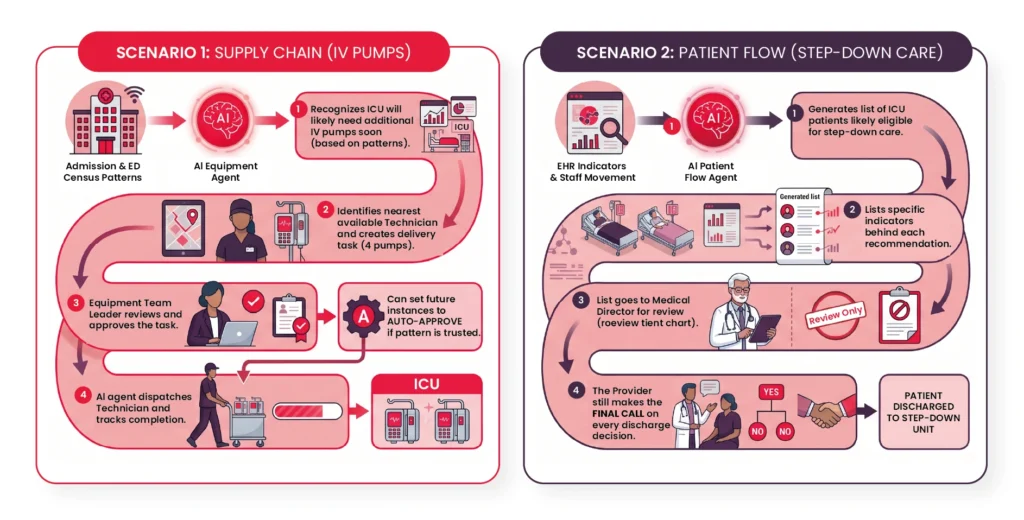
Consider a supply chain scenario. Based on admission and ED census patterns, an equipment agent recognizes the ICU will likely need additional IV pumps within the next several hours. It identifies the nearest available technician and creates a task to deliver four additional clean pumps to the unit. The equipment team leader reviews and approves the task before the agent dispatches the technician and tracks completion. If that team lead trusts the pattern after watching it play out, they can set future instances of that exact scenario to auto-approve.
A patient flow scenario works the same way. Drawing on EHR indicators and staff movement, a Patient Flow Agent generates a list of ICU patients who may be eligible for step-down care, along with the specific indicators behind each recommendation. That list goes to the medical director for review, not to the patient chart. The provider still makes the final call on every discharge decision the agent surfaces.
Closing the Trust Gap
When it comes to operational AI for healthcare, AI outputs are only the inputs to a human decision, and aren’t the decision itself. An insight, such as a scheduling optimization or prioritizing one treatment for faster patient discharge, must be approved and executed by a human employee.
For operations leaders, it’s important to understand how AIs arrive at any given recommendation. This requires sitting down with a vendor to discuss (and even customize) these outcomes: which data points should be weighted, where human approvals occur, or which outliers should be rejected. By tailoring an AI to the unique patient populations, staffing patterns, and supply chain of one particular health system, this AI becomes vastly more relevant and useful.
With these adjustments in place, hospitals can bridge the trust gap between clinicians and technology. Staff who once worried about being overridden by a black box start recognizing their own input in the system’s behavior, reducing their own mistrust and reaping the operational benefits of these technologies.