
What Happens When Care Progression is Delayed?
Delayed care progression remains a significant problem. In a study of 52 hospitals over three months, the Healthcare Association of New York State found that 1,115 patients accumulated 60,000 avoidable days at a cost of $169 million.
Another report from the Minnesota Hospital Association found that 101 hospitals generated almost 195,000 days of unnecessary care, costing an estimated $487 million. The MHA also found that this excess care was the key reason that nearly 67% of Minnesota hospitals reported operating losses in 2023.
To solve this problem, hospitals don’t need another dashboard. Instead, they need a way to extract insights from patient data; automatically convert these findings into actions, such as prioritizing different procedures or early discharges; and continuously improve their patient workflows and associated metrics, like revenue.
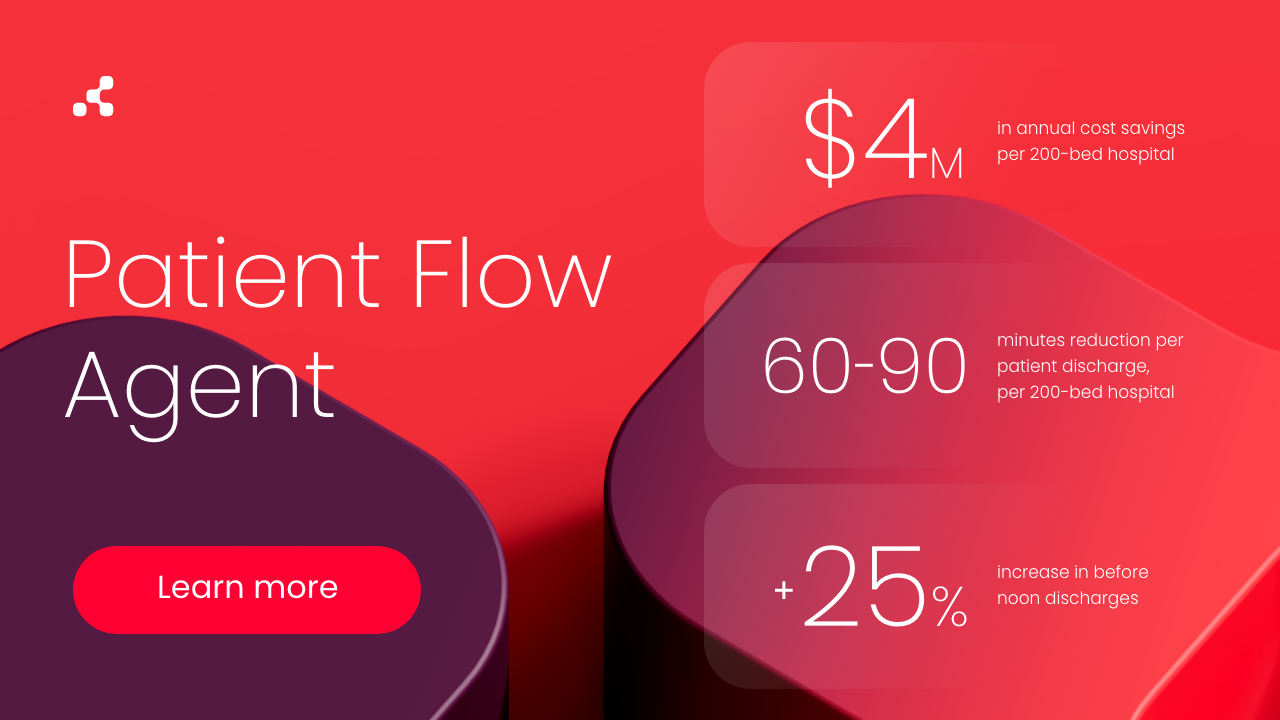
That’s where Patient Flow Agent comes in. At the individual patient level, a hypothetical 200-bed hospital uses the Agent to manage capacity more efficiently; this decreases discharge length by up to 90 minutes, turns rooms over more rapidly, and saves up to $130 in labor per discharge.
At the hospital-wide level, Patient Flow Agent streamlines patient journeys, reducing avoidable delays by 40%, and increasing before-noon discharges (vital for booking timebound inpatient services, for instance) by up to 25%. For the same 200-bed hospital, this could save up to $4 million in annual costs.
Here’s how Patient Flow Agent helps hospitals achieve these metrics.
Analyze + act on patient journeys
Modern healthcare environments generate reams upon reams of data in different formats: device readings, Epic workqueues, orders, transport events, and much more. Unlike humans, AIs excel at sifting through the sheer quantity of data for deep analysis and pattern recognition.
With this information, Patient Flow Agent can suggest the right interventions. For individual patients, this could be fast-track imaging or PT, reprioritizing consults, and pushing timely nudges in Epic, so that length of stay (LoS) drops and capacity peaks don’t turn into ED boarding. At the unit- or hospital-level, Patient Flow Agent can accelerate priority discharges or make recommendations to level load staffing.
Without analysis and actions from Patient Flow Agent, teams are working blind, lacking visibility into operational obstacles, key trends, and early warning signs of possible bottlenecks.
Forecast capacity and prevent ED boarding
By leveraging data and analytics, Patient Flow Agent can also help command centers alleviate pressure on extremely high-census days. Rather than scouring through long patient lists to find discharge or step-down candidates, the Agent scours EHR data and RTLS signals, identifying and flagging patients who are ready to transition to a lower level of care.
It can also anticipate census demand and nursing workload, and make suggestions for how to leverage float staff or unit staff to alleviate the hardest hit units.
Prioritize work by impact, not arrival order
Ancillary queues, such as imaging, physical or occupational therapy, and consults, are often ordered by first-in, first-out. While simple, this isn’t always the most effective approach, as these services can often have significant effects on a patient’s length of stay.
Instead, Patient Flow Agent gives priority to services that will impact an individual patient’s length of stay. For instance, if imaging is vital to a patient’s care progression, then the Agent can fast track that patient for a CT scan; if another important service (like occupational therapy) was missed, then the Agent can send a reminder to therapists to return to a room when patients are present.
Either way, the result is the same: patients will no longer have to wait endlessly for key services, and can instead get ancillary services done sooner, and get discharged faster.

Scale, configure, and integrate solutions with ease
In addition, hospital employees already have plenty of tools and dashboards to train on and keep track of. Instead of adding yet another tool to the mix, Patient Flow Agent integrates with EHRs and existing technologies. As with other Kontakt.io products, the Agent was also created to be highly scalable, growing from single wings to entire hospitals and IDNs.
Because every hospital is different, dealing with unique circumstances, census rhythms, and nuances, Patient Flow Agent is fully configurable at the site and unit level. That way, hospitals can tune prioritization weights (ICU versus Med-Surg), discharge targets, alert thresholds, and more.
Equally important, the Agent improves its performance with time and use, learning from outcomes and human feedback. It will analyze accepted and ignored recommendations, local overrides, time-to-completion, and other metrics in order to fine tune outputs.
Conclusion
In an age of increasing data, hospitals need an intelligent orchestrator that can convert data into targeted interventions and results. Patient Flow Agent helps teams shift to a proactive stance, shortening stays and preventing boarding before it begins.


