How Hospitals Manage Equipment Complexity with Orchestration
Key takeaways
- Most health systems have enough equipment to meet demand; the problem is that siloed distribution means the right device is rarely in the right place at the right time.
- When units manage their own equipment independently, they optimize for their own survival, not the system’s performance, resulting in hoarding, over-purchasing, and rental overruns.
- The ROI from orchestration comes not from more purchases, but from using what health systems already own, distributed intelligently across the units and campuses that need it most.
- The fastest path to equipment availability isn’t buying more – it’s connecting units so inventory can be balanced. Johns Hopkins raised the number of care areas at safe pump levels by 44% with zero new pumps purchased.
A 900-bed academic medical center does not have three times the coordination problem of a 300-bed community hospital. The complexity scales exponentially rather than linearly, because every workflow in a large health system touches another, and the failure of one cascades into the next.
That relationship between workflows is where the real operational challenge lives, and most health systems are managing it with tools designed for a simpler problem.

Why do Large Hospitals Over-Purchase Equipment?
Most hospital leaders understand that size brings coordination challenges. What they underestimate is where those challenges actually originate: not in the number of devices, beds, or service lines, but in the connections between them.
For instance, a community hospital manages discrete problems: a patient arrives, receives treatment, and moves on. When something goes wrong, the consequences stay relatively contained.
In contrast, an everything-hospital, which runs transplant, cardiac, oncology, neonatal, and trauma programs simultaneously, manages a system where every subsystem depends on every other. This means that a delay in one department will not stay there, and instead will quickly cascade to other units.
The conventional response to that complexity has been siloing: assign equipment by unit, set par levels by memory, manage each campus independently. This seems logical: by carving out autonomy for individual units or campuses, decision making is devolved to the people who are most affected by equipment shortages, and the most motivated to resolve them.
For a unit manager who has been burned by shortages before, owning the inventory feels like the only reliable solution. At a single-campus hospital with fewer moving parts, that instinct is correct. The problem surfaces when the same logic is applied across a multi-campus health system running dozens of service lines simultaneously, because what benefits one unit will hurt another.

What’s the ROI of Tracking Hospital Equipment Utilization?
The case for connecting this information (via orchestration) is simple: silos worsen complexity and shortages, rather than containing them.
At this level of scale and complexity, cascade failures are the result of a system where units are both highly interdependent on each other, yet in the dark about what everyone else is doing.
Without a layer linking those wings or campuses, each siloed unit operates on incomplete information, unable to see what the unit next door has, needs, or is about to run short of.
Therefore, one small failure will quickly spread through a hospital or health system, because every subsystem (hospital wings or individual campuses) has only been optimized for their own performance, and not the performance of the system as a whole. This results in:
- Clinicians spending up to 10% of their time dealing with operational failures stemming from siloed supply chain departments.
- Hospitals solving the problem with brute force; for instance, a 300 bed hospital buys 900 pumps because it cannot trust its own processes.
- Nurses wasting up to 60 minutes per shift searching for equipment, because devices are not equitably distributed across the campus or system.
However, past a certain size and complexity threshold, the brute force approach breaks down, as the cost of excess inventory or endless equipment searches accumulate faster than budgets and workforces can absorb.
How do Large Hospital Campuses Coordinate Movement of Mobile Equipment Fleets Across Buildings?
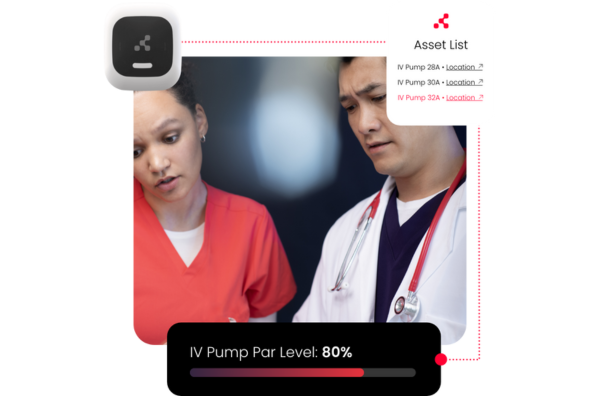
The answer is to connect these divided subsystems by providing visibility and orchestration. A peer-reviewed study at The Johns Hopkins Hospital quantified this dynamic directly: across a network of 3,832 infusion pumps and 93 care areas, up to 17% of a unit’s pump inventory was explained by fluctuations in neighboring units; shortages in one area were partly a consequence of surpluses in another. When the hospital deployed a system-wide inventory balancing tool to connect those units, the number of care areas operating above safe inventory levels increased by 44%, without a single additional pump being purchased.
Intelligent orchestration connects the silos that isolation created, pooling equipment across units and campuses, balancing supply against predicted demand, and routing tasks to the right person before a shortage becomes a crisis. When equipment moves based on where it will be needed in two hours rather than where it was last seen, the cascade breaks before it starts. When a supply tech works from a prioritized task queue generated by the system rather than responding to shortage calls, the gap between visibility and action closes without requiring a human coordinator to bridge it manually.
In addition to clinicians, patients will also benefit from orchestration. By improving device distribution and routing, hospitals cut out unnecessary tasks (like equipment searches) and gain an efficiency bonus. This means shorter wait times for admitted patients, faster turnarounds for ED patients, and less time spent waiting for beds, procedures, and discharges.
This is the logical conclusion of two decades of RTLS investment. Hospitals have spent years building the infrastructure to know where everything is. The step that follows is a system that acts on what that infrastructure already knows, converting location data into coordinated decisions across the entire health system rather than leaving each unit to interpret and act on its own fragment of the picture.
How do Multi-Campus Systems Coordinate Mobile Equipment Fleets?
Disconnection, not complexity, is the operational enemy of large health systems. The study makes this plain: a hospital with 3,832 pumps still ran short because it lacked the coordination layer to move that inventory to where it was needed.
An everything-hospital that connects its silos, across equipment, staff, workflows, and campuses, will still face unpredictability, whether that takes the form of a mass casualty event, a sudden census spike, or a seasonal surge that triples demand overnight. The difference is that a health system with orchestration has a structurally better chance of preventing that unpredictability from becoming a cascade.
Complexity will always be present, but whether it becomes a crisis will depend on the degree of connection and orchestration.