
The Snowball Effect of Hospital Delays and the AI Built to Stop It
Hospitals run near capacity, so small delays cascade into system-wide congestion, including overstays, staff burnout, and financial losses. One study from the Annals of Emergency Medicine found that ED boarding cost $1,856 per patient per day, nearly double the cost of inpatient care ($993).
Yet cost is only half the story; even marginal improvements led to significant savings in expenditures, provider time, and hospital space. A 2011 study found that a one hour reduction in ED boarding time could recapture up to $13,000 in daily revenue, while further research revealed that sustained reductions in ED boarding (from 11.9 to 1.2 hours) and length of stay (from 11.5 to 4.4 days) saved nearly $32 million.
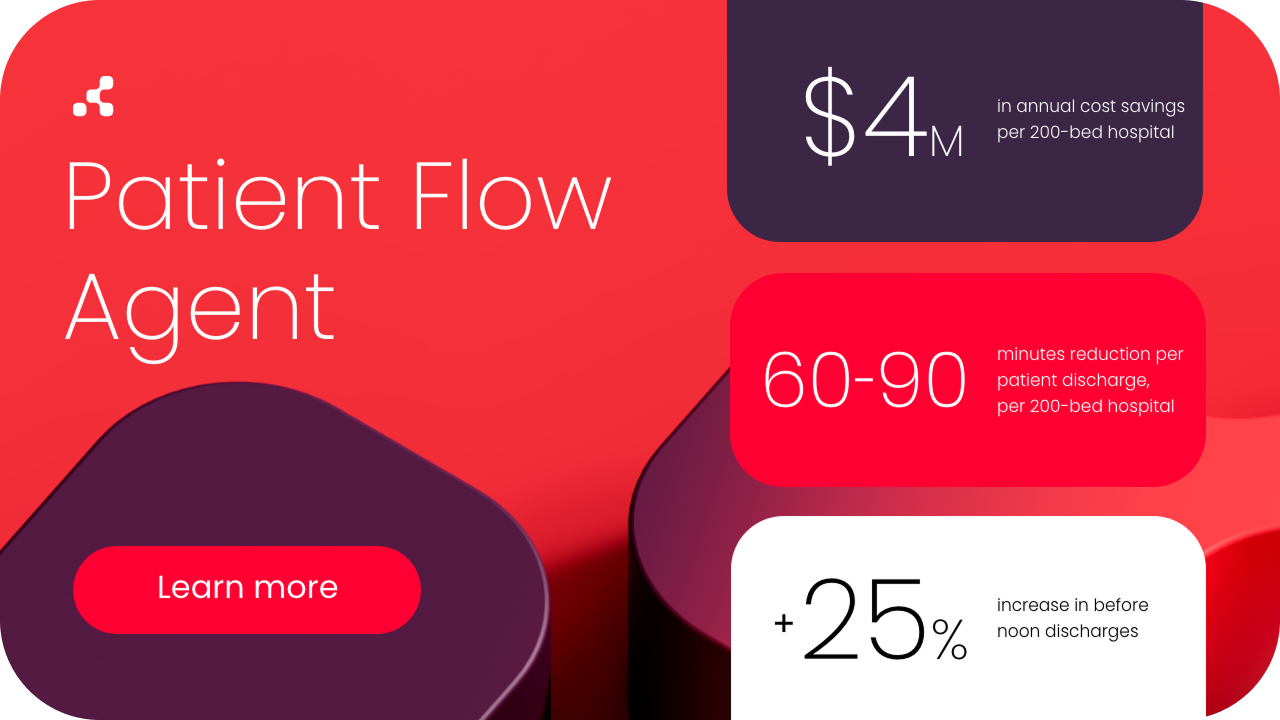
In fact, hospital flow issues are both well-documented and solvable. Kontakt.io designed Patient Journey Analytics and Patient Flow Agent to unify and empower frontline care teams to reduce length of stay and reclaim resources, revenue, and provider time.
How We Approached The Problem
These operational obstacles are examples of nonlinear congestion, a principle first observed in computer science and traffic control, where small variations have outsized effects on outputs. Just as a few cars slowing slightly to gawk at a crash will create hours-long traffic jams on a highway, a single delayed ICU step-down can cascade into ED boarding and off-service placement for several other patients.
Because so many hospitals operate on a huge scale, ingesting, sorting, and analyzing this data is near impossible for human minds, but a perfect fit for algorithmic ones. While human minds struggle with the scope of such data, AIs excel at massive, monotonous analysis, combing through millions of data points and terabytes of data to uncover patterns and blindspots.
In addition, AI agents also offer advantages over traditional dashboards and UIs, especially when autonomy and adaptability are required. Because hospital operations are dynamic and complex, any AI agent has to continuously process events, instantaneously update users, and intelligently adapt to changing circumstances. If a MRI schedule slot suddenly opens up, then the AI agent has to immediately identify the best patient to fill it, inform the care team, and route the patient accordingly.
What is Patient Journey Analytics?
But none of that is possible without the right foundation. If AI agents are to cut through the operational fog, they need massive quantities of data and a way to process and extract insights from such data. It comes back to size: because so much is happening in a single hospital, real-time visibility requires intensive data ingestion, analysis, and synthesis. In addition, this all happens on a very tight timeline, as hospitals are 24/7 operations.
That’s where Patient Journey Analytics comes in; it deploys the strengths of AI, such as constant iteration, reinforcement learning, and global optimization to deep-rooted operational challenges. It can fuse historical and real-time data from multiple sources (EHR, RTLS, CMMS), map out past patient journeys in exact detail, and simulate future ones, all to better predict upcoming demand and potential bottlenecks.

How Do Patient Flow Agent and Patient Journey Analytics Work Together?
If Patient Journey Analytics is the foundation that provides intelligence and insights, then Patient Flow Agent is the action arm. Where Patient Journey Analytics will act as the central nervous system, crunching data, and reconciling the output from different agents, Patient Flow Agent will intervene, surfacing important patient flow context and nudges that accelerate care progression.
Patient Journey Analytics also provides a shared operating framework to downstream agents, serving as a single source of truth and context, and reconciling any conflicts that arise. For instance, if Patient Flow Agent requires a device to be staged at an OR for surgery, but Supply Chain Agent disagrees and decides to reallocate it to a separate room, then Patient Journey Analytics will intercede, making a final decision based on its preconfigured logic and parameters.
Importantly, Patient Journey Analytics also provides compliance for all its dependent AI agents, in the form of audit trails, data governance, access controls, and HIPAA adherence. This not only satisfies key regulatory requirements, but it also allows hospital teams to analyze why decisions were made and how they impacted operations. This layer of security is crucial for working in a highly regulated environment such as healthcare.
Why Your Hospital Needs Patient Journey Analytics and Patient Flow Agent
To reclaim revenue, patient access, and provider capacity, Kontakt.io created Patient Journey Analytics, serving as the brain, while Patient Flow Agent serves as one of its arms. This way, hospitals can adapt to (or prevent) unexpected surges, ensure that operations remain seamless, and focus on what really matters: delivering the best care to their patients.


