
How to Be a Visionary Pragmatist in Healthcare
Key Takeaways
- A “visionary pragmatist” sounds paradoxical, but it simply means holding emerging technologies (like AI) accountable. This entails selecting a single domain, setting a time limit (usually 14-30 days), and ensuring that the technology brings tangible ROI and benefits.
- Too many healthcare technology vendors charge hospitals by hardware, such as devices or trackers. Instead, vendors should price by outcomes, such as reductions in length of stay, decreased equipment search time, and increased capacity.
- With solutions like AI and machine learning, the primary obstacle to optimizing real-world hospital operations is not technology, but data.
As with other industries (and society as a whole), healthcare is undergoing rapid, sustained technological transformation. The rise of emerging technologies like AI has created tangible ROI and benefits for health systems, patients, and clinicians, but its fast pace also brings with it buzzwords and confusion.

What does it mean to be AI-first? How can health systems seize these innovations to drive real, lasting change?
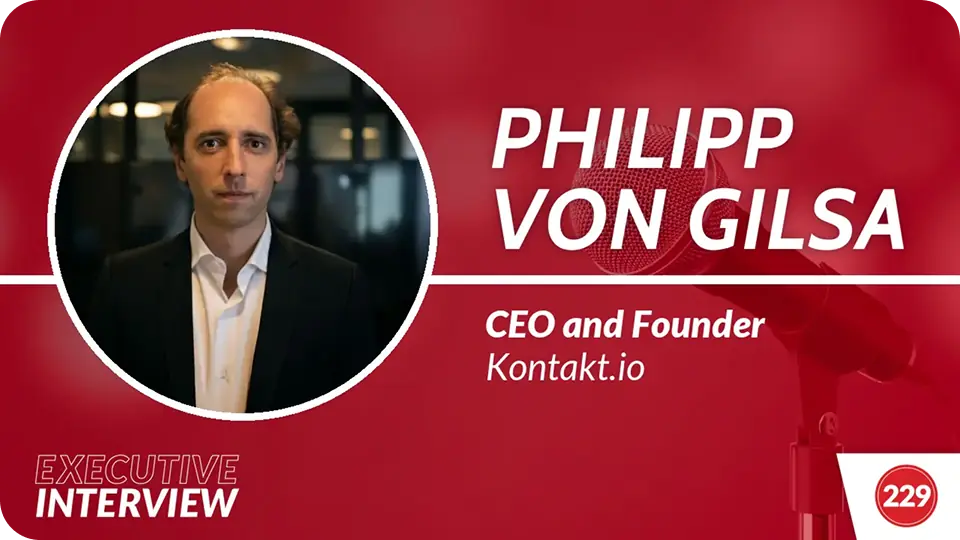
As someone at the forefront of this wave, Kontakt.io CEO Philipp von Gilsa has an idea of what it takes to reimagine how health systems operate, and how this can translate into better experiences for patients and clinicians alike. Recently, Philipp sat down with 229 founder (and longtime healthcare leader) Bill Russell for an episode of the 229 Project podcast to talk about exactly this problem.
Here are some brief snippets from their discussion.
How to Get AI to Work for Your Health System
For too many health systems, AI investments have been inflationary, rather than cost-saving. To get around this problem and make AI a cost-effective investment, healthcare leaders should be visionary pragmatists, Philipp argues.
“You need to take on a problem set or solution domain, where within 30 days, you can point to hard ROI that hits the P and L,” Philipp says. “Very often, these were often the domains that people have been trying to go after for a long time.”
Focus on Outcomes, Not Hardware
Traditionally, vendors would sell hardware to hospitals, in the form of device trackers, staff duress badges, and room sensors. But Philipp argues that a better model would be outcomes as a service; rather than charging by badge or tracker, vendors would better serve health systems by charging based on outcome: reducing clinically unnecessary days, improving duress response times, or scaling clinic capacity.
Data as the Primary Bottleneck
In an era of abundant, low-cost data, the primary bottleneck for healthcare operational efficiency isn’t necessarily AI, but the volume of high-quality, real-time data. Gathering continuous time-series data allows AI agents to optimize these physical operations.
“With this intelligence abundance,” Philipp explains, “it is so cheap to translate information into workflows that are then driving automation. What used to take a lot of effort can be done extremely fast, and is extremely scalable.”
To listen to Philipp’s conversation with Bill Russell, including more information on AI as a physical context layer, click here.
